Continue the repair task from the first chapter. You ask Hermes to fix a failing test, then add one sentence: "Do not edit generated files directly in this repository." A few days later it enters the same directory again. The useful behavior is not merely preserving those words. Hermes first has to recognize what they are: a constraint for this task, a durable repository rule, or a preference that follows you across every project.
Put the sentence only in the current transcript and a later turn may not retrieve it. Put it in
USER.md and unrelated repositories may inherit it. Put it in the project's
AGENTS.md and it follows that repository, which is correct only when the rule truly belongs to
the project. Turn it into a Skill and a one-line prohibition has been mistaken for a procedure. Before an
agent can "remember," it must decide where the information applies, how long it lives, and when it
should appear again.
Questions this article answers. By the end, you should be able to classify a new piece of information as an instruction, preference, piece of evidence, reusable procedure, or one-off state before naming any Hermes file. You should then be able to explain why it belongs in a system-prompt tier, Memory, SessionDB, a Skill, or the transcript only.
This chapter follows a fixed source snapshot verified on September 20, 2026. Prompt tiers, session snapshots, and history reads are implementation facts; the placement method is a reading aid inferred from them. Tool guidance says what should be stored, but the file store does not prove that a fact has durable value.
1. Classify the information before choosing a file
A beginner's first impulse is often to start from a product noun: "Should this go into Memory?" A more reliable sequence starts with four ordinary questions.
| Question | Possible answer for the generated-file rule | What it decides |
|---|---|---|
| Who does it constrain? | This repository only, or this user in every project. | Project Context and a user profile cannot substitute for each other. |
| How long should it live? | Until this task ends, or whenever the repository is opened. | A transcript entry and durable state make different promises. |
| Is it a fact, evidence, or a method? | A preference is a fact; a failed log is evidence; regeneration is a method. | Memory, SessionDB, and Skills cannot substitute for each other. |
| When should it reappear? | At workspace entry, or only when a matching task occurs. | Always-on prompt material differs from on-demand retrieval. |
The order is simple: scope first, then lifetime, then information type, then read timing. The tiers and storage locations in Hermes implement those decisions. Start with the system prompt, because it is the instruction text the model receives before doing any work.
2. A system prompt is not one large bag
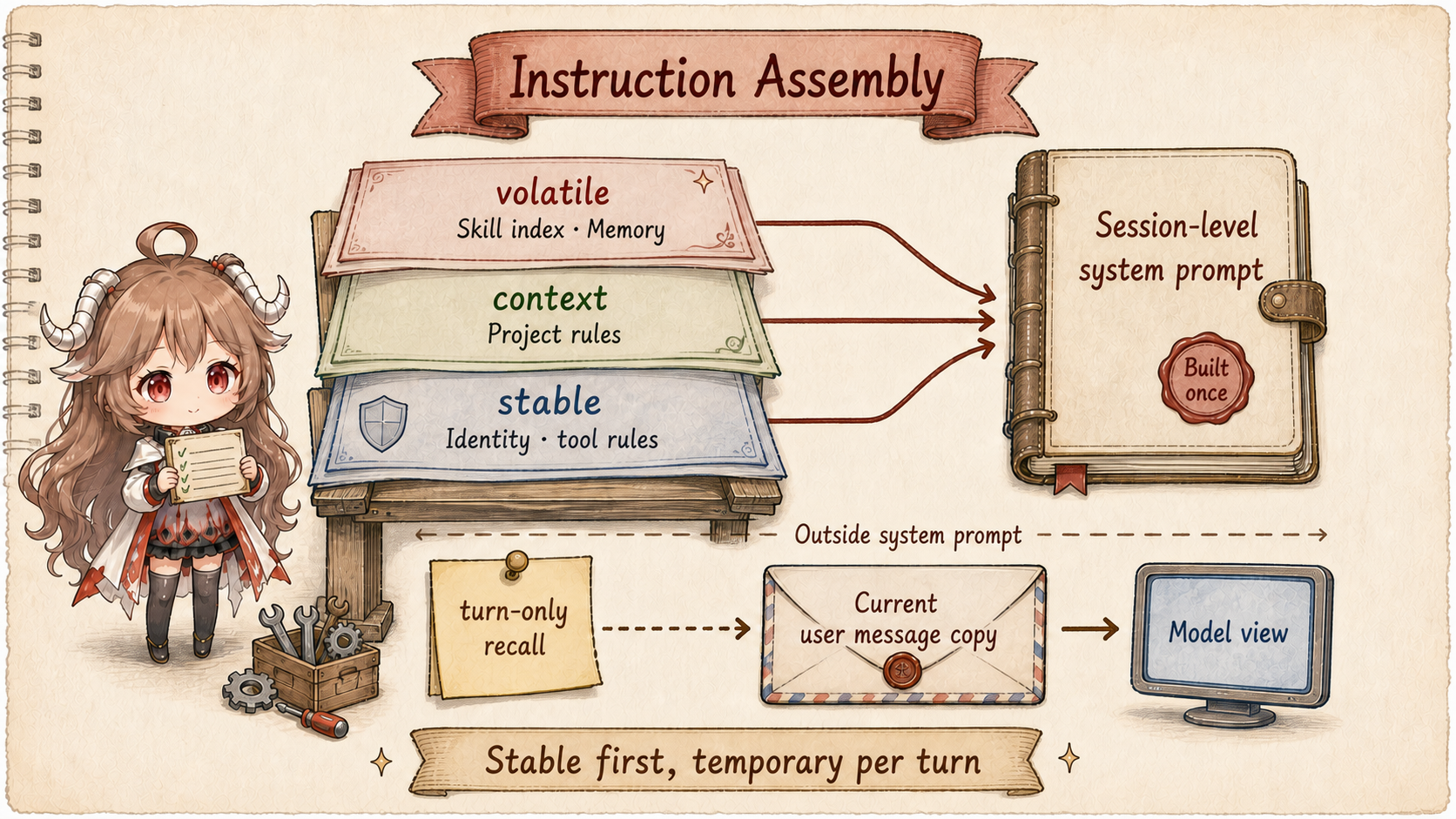
A model call needs an opening instruction that explains identity, tools, and current workspace rules. That opening is the system prompt. An implementation can simply concatenate identity, tool help, project files, user preferences, the date, and temporary search results. It will run, but every small change can disturb the front of the request, and the origin of each rule becomes progressively harder to audit.
Hermes instead uses
build_system_prompt_parts
to place material into three ordered tiers before joining it once. The order does not rank importance. It
ranks how likely the bytes are to remain stable across sessions and rebuilds.
The opening instruction-assembly desk draws that relationship as two routes. Three tiers become one session-level system prompt on the workbench; turn-only recall stays in the lower lane and changes only the current model input. The next sections explain why each piece belongs where it is drawn.
2.1 What stable, context, and volatile protect
stable comes first. It contains identity, general tool guidance, completion rules, and other
relatively stable runtime instructions. Its invariant is a reusable prefix: when these bytes stay fixed,
an upstream provider has a better chance of reusing prompt-cache work.
context carries workspace-dependent material: the caller-supplied system message, project Context files, then the coding workspace snapshot and remaining workspace guidance. It is not universal identity, but it normally stays fixed
through one project session. Keeping it separate also makes the authority of a rule visible.
volatile contains material most likely to differ on the next rebuild: the Skill index,
MEMORY.md, USER.md, an external memory-provider block, frozen plugin sections, conversation-start time, and runtime environment hints.
Placing it last protects the longer prefix when the tail changes. Yet volatile does not mean
rebuilt every turn. The complete result is cached on the current AIAgent by
build_system_prompt
and is normally constructed once per session. Invalidation after compaction reloads Memory; restore first reuses persisted prompt bytes and rebuilds only when compatibility checks require it.
return {
    "stable": "\n\n".join(stable_parts),
    "context": "\n\n".join(context_parts),
    "volatile": "\n\n".join(volatile_parts),
}
This snapshot rule explains a seemingly surprising behavior. A Memory tool call can write a new preference to disk during the current turn without rewriting the system prompt already in use. The disk truth and the current model's session snapshot have different lifetimes; the write did not fail.
2.2 Project Context selects a category, then merges directory rules
When a repository contains several instruction formats, Hermes chooses the first project-rule category with readable, nonempty content:
.hermes.md/HERMES.md, then the AGENTS directory chain, then cwd-level CLAUDE.md/claude.md, and finally Cursor rules.
The or chain in build_context_files_prompt selects one category, not necessarily one file.
SOUL.md in the user's configuration directory remains an independent identity source.
For AGENTS, directory discovery walks from the Git root to cwd and merges in that order.
Each directory contributes its first readable, nonempty AGENTS.override.md, AGENTS.md, or agents.md.
Identical content is deduplicated and source labels are retained. Outside a Git repository, only cwd is checked.
Repository-root AGENTS.md: do not edit generated files directly
packages/api/AGENTS.override.md: run this directory's schema generator
Current directory: packages/api

No HERMES rule found → select the AGENTS category
Root rules → api directory rules → assembled project Context
A nonempty override shadows AGENTS.md in that directory; CLAUDE is not loaded
Shared rules come first and local rules follow. Repository conventions belong in selected project Context and remain reviewable with the code; copying them into user Memory would carry them into every session. This is text assembly: adherence still depends on the model and execution controls.
2.3 Why turn-only material is not a fourth system-prompt tier
While fixing the test, an external memory provider may retrieve one related note and a plugin may add
request-specific context. These facts serve the current decision only. Hermes does not add a fourth
system-prompt tier. Instead,
compose_user_api_content
appends them to the API copy of the current user message.
The stored user text remains "fix the failing test," while the model-bound copy can contain that request
plus recalled context. Hermes persists the exact sent bytes in an api_content sidecar near the
end of turn setup; see
the sidecar stamp.
Replay can therefore send the same bytes without pretending the temporary material was part of the user's
original message.
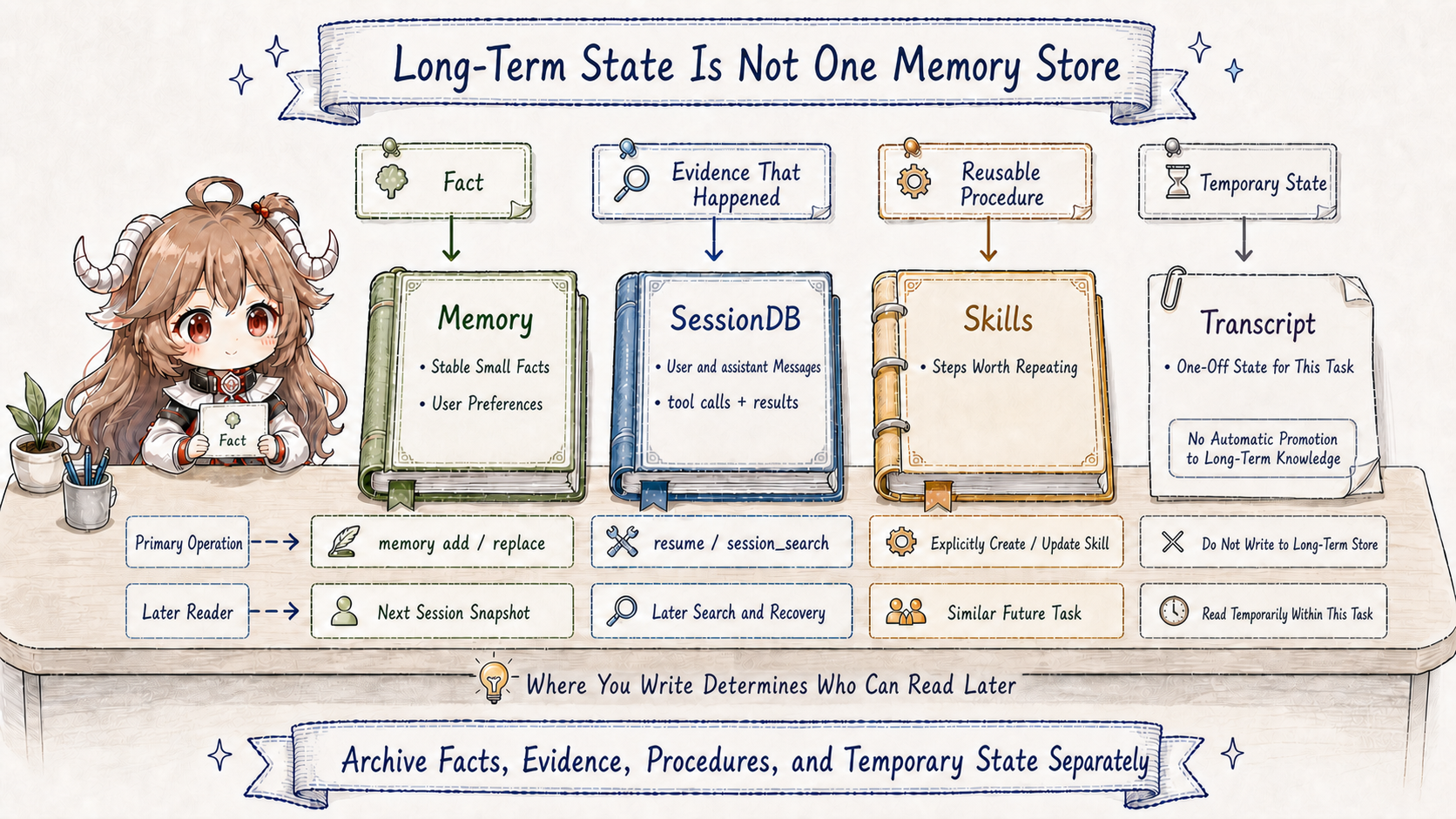
3. Durable state is three different promises
Now move from what the model sees now to what future work can recover. A preference, a failed log, and a reusable repair procedure may all help later, but each promises something different: a small fact remains true, an event really happened, or a method can be applied to another task.
3.1 Memory: small stable facts for the next snapshot
Built-in Hermes Memory is not an unlimited vector database. It is two bounded, auditable files.
MEMORY.md stores short environment and agent facts; USER.md stores user preferences
and communication style. Their default budgets remain 2,200 and 1,375 characters. Current tool guidance requires facts to apply to every session, regardless of task. Preferences, corrections, and pitfalls for a particular kind of work belong in its Skill; identity, stable environment facts, and standing conventions without a more specific home fit Memory.
MemoryStore
maintains live entries and a frozen system-prompt snapshot. At session start, disk entries are scanned for
threat patterns before the snapshot is formed. Calls to add and replace update live
state and disk without silently mutating the snapshot already given to the model.
Writes also have explicit rejection conditions. Empty content, injection and exfiltration patterns, character-budget overflow, and read failures are rejected. Adding an existing entry succeeds without duplicating it. A replacement that matches multiple
different entries is not guessed. Those checks are visible in
add and replace.
The longer a fact is expected to live, the more conservative its write path should be.
3.2 SessionDB: preserve what happened without rewriting it
When you ask, "What was the failed command last time?" you need evidence rather than a long-term
preference. Hermes stores user messages, assistant messages, tool calls, and tool results in a SQLite
session database. session_search queries its FTS5 indexes and does not call another model, so
its windows come from real stored messages rather than a freshly generated summary.
The discovery path calls db.search_messages and deduplicates by session lineage. Default detail="adaptive" fully expands only the top-ranked result with an anchored window and bookends; detail="full" expands every result. See
_discover.
Compact results retain match_message_id for a follow-up around_message_id read. Same-lineage records still in live context are normally excluded, while records archived by compaction or removed from live context by a session reset remain discoverable.
3.3 Skills: preserve how to act, not merely what happened
Suppose the repair reveals a reusable procedure: change the schema, run the generator, then verify that
the generated diff contains no manual edits. That is no longer a fact. It is procedural memory. The
system prompt normally carries a compact Skill index, and the model loads the full body with skill_view when a task matches. Explicitly preloaded fixed Skills are an exception.
The current
build_skills_system_prompt
uses an in-process LRU and a disk snapshot to accelerate index construction. That does not mean
Hermes evicts Skill knowledge by LRU. The cache stores the rendered directory; it is not a value ranking
for Skills. The next chapter will trace the separate Curator lifecycle.
skill_manage
advertises an operations array: create, patch, delete, and write_file/remove_file for supporting files. Ordinary write failures roll back every touched Skill; delete must be the only operation in its call. Legacy flat single-operation arguments remain accepted for historical transcripts and staged-write replay; patch with content performs a full rewrite. Successful writes clear index caches without reordering the current cached session prompt.
If the regeneration procedure and its verification note must change together, submit one batch. This is a valid call shape omitting unrelated Skill content; read existing targets before writing.
{
  "operations": [
    {"action": "patch", "name": "regenerate-api", "old_string": "Run the generator", "new_string": "Change the schema, then run the generator"},
    {"action": "write_file", "name": "regenerate-api", "file_path": "references/verification.md", "file_content": "Inspect the generated diff and run API tests."}
  ]
}
If the second operation fails, the first must not leave a partial update. The batch implementation holds all target locks through commit or rollback. A filesystem failure during rollback retains snapshots for recovery, so error results still matter. Staging under an enabled approval gate is not a completed write. Memory also supports atomic operations checked against the final character budget, so one batch can replace old facts and add new ones.
4. One sentence in five locations produces five behaviors
Run a counterfactual with the same generated-file rule. Its location changes how and when the runtime applies it.
| Stored in | Use it when | How it reappears | Cost of a wrong placement |
|---|---|---|---|
| Project Context | Every contributor and task in this repository should follow the rule. | A new workspace session loads the authoritative Context file. | Competing rule files make authority ambiguous. |
USER.md |
The preference is stable across the user's projects. | The next user-profile snapshot enters the volatile tail. | A local repository policy leaks into unrelated work. |
| SessionDB | You need proof of when the user said it and in what context. | session_search retrieves the real message window. |
A summary can erase wording and surrounding evidence. |
| Skill | There is a reusable procedure for regenerating safely. | An index match leads to on-demand loading of the full procedure. | A preference becomes a heavy, poorly triggered workflow. |
| Transcript only | The constraint applies only to the current task. | It remains available for recovery and audit, not always-on prompting. | Premature persistence hardens temporary state into policy. |
5. Walk one user sentence to its correct storage location
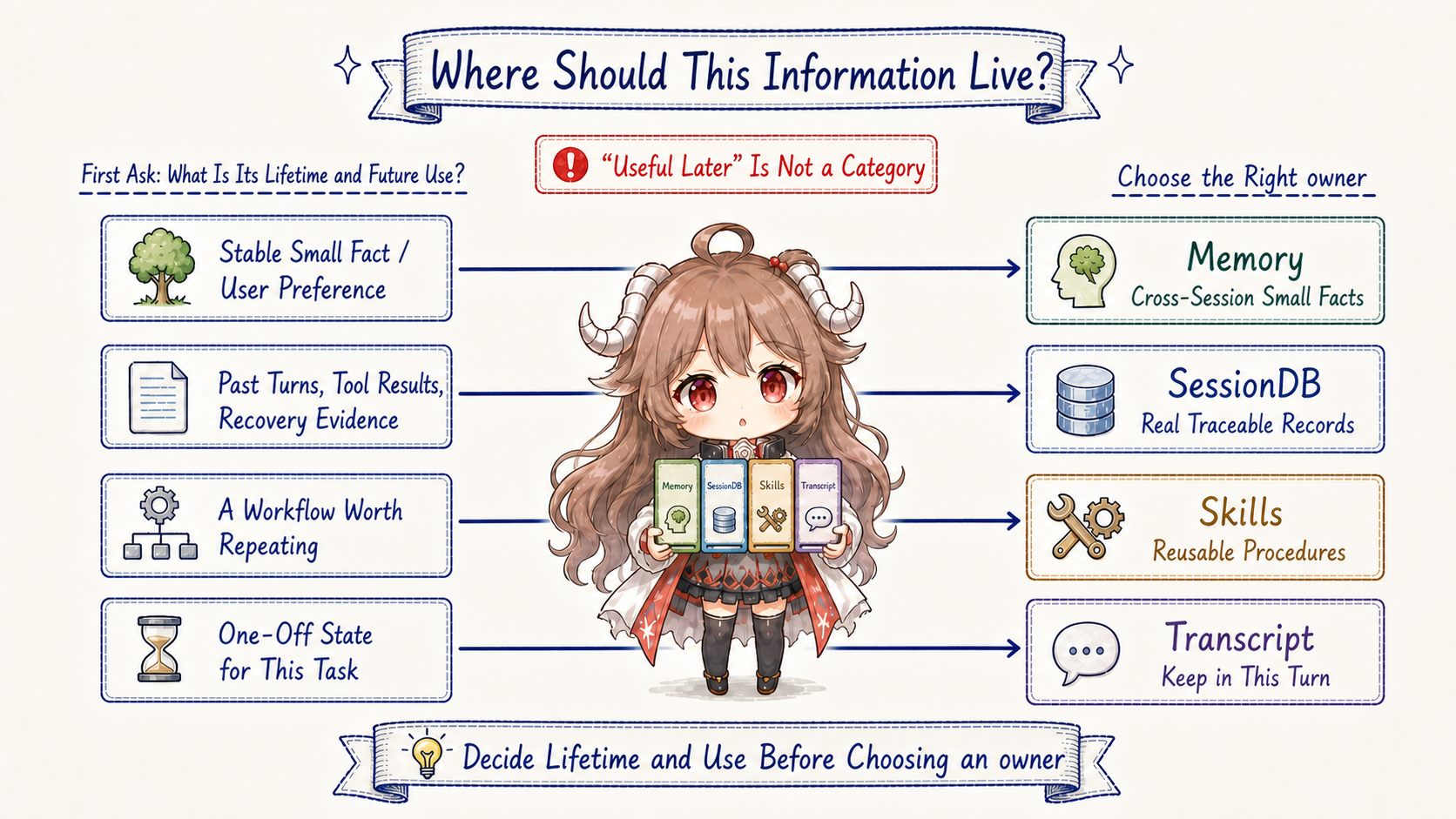
Compress the chapter into one replayable decision. The user says, "Do not edit generated files for this task." First preserve the original words in the transcript so the turn can recover after a crash. Let the current model input include them, change the schema rather than the generated output, run the generator, and deliver the task. The word "remember" is not itself permission to write long-term state.
Only then inspect scope. If the repository's authoritative Context file already carries the rule, do not
duplicate it. If the user explicitly makes it a stable preference across projects, distill one short
USER.md fact. If the reusable part is the regeneration and verification procedure, patch a
matching Skill. Otherwise preserve only history. SessionDB already satisfies "find the original later,"
so choosing not to create long-term state is not the same as forgetting.
Preserve the words and finish the current task.
Then determine their scope.
Facts go to Memory, evidence stays in SessionDB, methods become Skills.
Without durable value, keep only the transcript.
This is not one literal if function in Hermes. It is a reading method derived from the public
read and write behavior of each component. Its central distinction is that real history should be preserved early, while
distilling that history into durable state requires a higher threshold.
6. Conclusion: state design is about future visibility
The source names now form one route. The system prompt determines which instructions a session starts with. Project Context supplies repository authority. Memory supplies compact stable facts. SessionDB preserves searchable evidence. Skills hold procedures loaded on demand. Turn-only material changes only the API copy of the current user message.
These mechanisms differ by more than file format. They assign who can write, when a reader sees the result, whether the current session changes immediately, and which copy remains authoritative after a failure. The useful question is no longer "Which memory should hold this?" It is: in which future situation should which component make this information visible to the model?
Knowing where experience belongs still does not explain how a completed task becomes a candidate fact or procedure. The next chapter starts at the finalizer and follows background review, nudges, and periodic Curator by their different triggers and write timing, explaining how background work stays separate from the foreground answer.
Sources
- Fixed source snapshot: NousResearch/hermes-agent
- three-tier system-prompt assembly
- context, volatile, and final assembly
- project Context priority
- turn-only api_content composition and replay
- Memory live state and frozen snapshot
- Memory write protections
- SessionDB FTS5 discovery
- two-layer Skill-index cache
- skill_manage writes and cache invalidation