1. Why a refund assistant cannot be only an Agent
Consider a refund assistant. User language is open-ended: “the size is wrong,” “the parcel never arrived,” or
“I want another color” all require intent recognition, follow-up questions, and order lookup. The refund procedure
cannot be equally open-ended: check the order, evaluate policy, request approval when risk is high, and only then
write the refund. That split is why ADK puts Agent and Workflow together.
A prompt that says “check the order, then policy, then refund” may work once and skip a step later, or repeat a write during retry. Hard-coded control alone has the opposite problem: it cannot understand a new phrasing, request missing information, or choose a useful tool. The assistant needs autonomy and deterministic control to hand work to each other.
2. Five roles to learn first
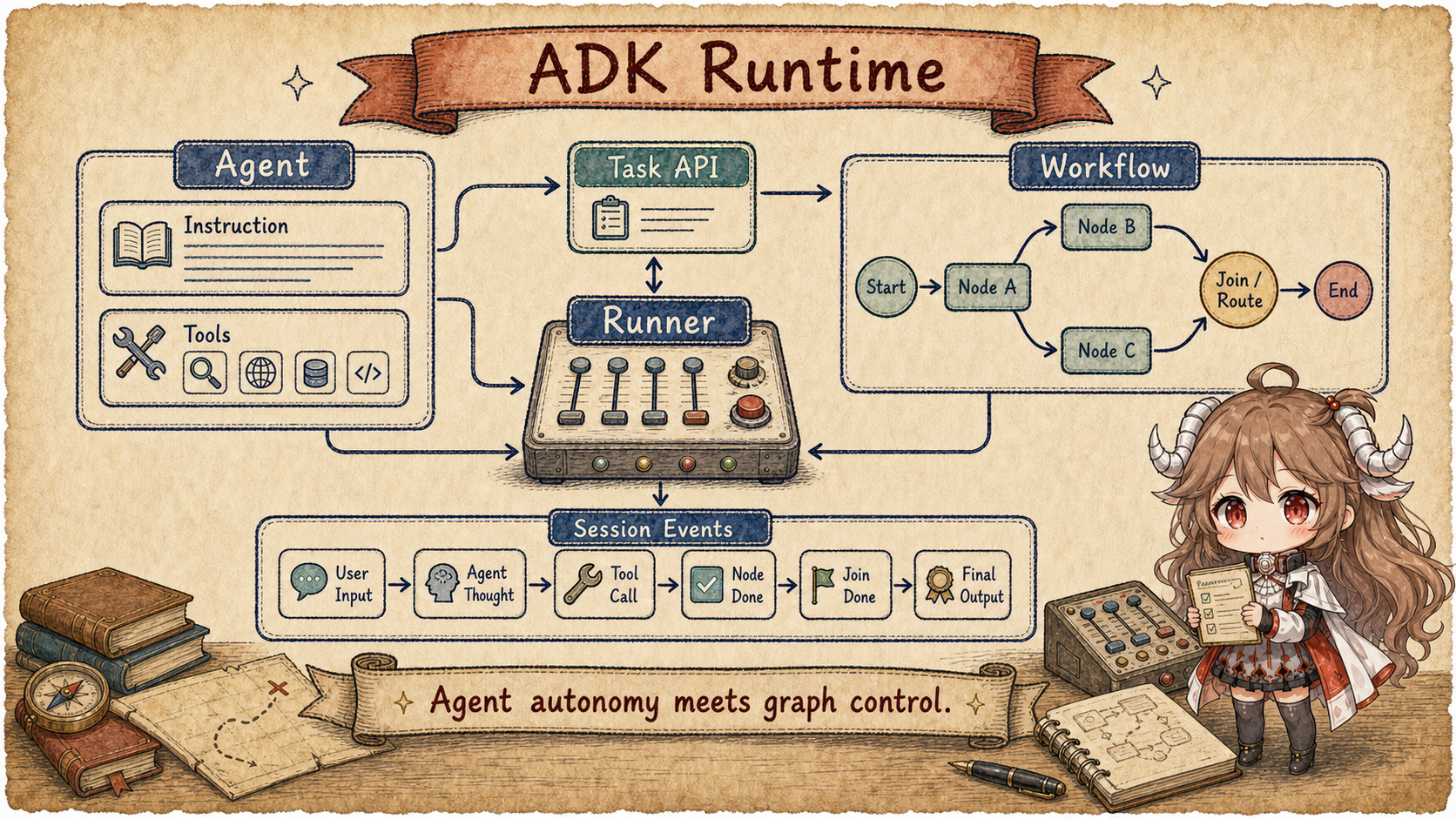
- Agent: understands language, asks follow-up questions, chooses tools, and makes open judgments.
- Workflow: owns the graph: parallel steps, joins, branches, and required ordering.
- Runner: starts a run and connects an Agent or Workflow to users, sessions, and services.
- Event: records facts such as node start, output, approval wait, and completion.
- Task API: delegates structured work to another Agent and requires an explicit completion result.
The minimal refund route needs the first four. Task API enters only when policy review becomes a specialist-agent job. Introducing it at that moment explains its purpose better than memorizing the full API up front.
3. How one refund reaches completion
Runner chooses between a root LlmAgent and a root
BaseNode. It does not automatically run a chat Agent and then enter a Workflow. This example
therefore chooses a root Workflow so deterministic steps can be resumed. Its first node is an
LlmAgent(single_turn) that interprets the user's language; order lookup, policy, approval, and the final
write are later nodes. A root chat Agent could instead call a Workflow through an explicit application integration,
but the two designs are alternative entry routes, not an undocumented sequence.
- Runner finds the user's session and gives “the shoe size is wrong” to the root Workflow.
- The intake Agent node emits a structured order id and reason, requests missing data when needed, then starts order and policy checks.
- Each check emits Events. Workflow waits for both instead of asking the model to remember progress.
- Eligible low-risk work takes the automatic route; high-risk work pauses in a human-approval branch.
- If a specialist Agent checks policy, Task API requires a structured result that explicitly completes the task.
- Runner stores process events and the final result in the session while streaming them to the caller.
Keep one division in mind: Agent owns understanding and judgment, Workflow owns required execution order, and Runner owns how the run becomes observable and recoverable.
ADK Python's README puts two items up front in 2.0: Workflow Runtime and Task API. Workflow Runtime is described as a graph-based engine for routing, fan-out/fan-in, loops, retry, state management, dynamic nodes, human-in-the-loop, and nested workflows. Task API is structured agent-to-agent delegation. That is the framework stance: the 2.0 highlights place autonomous agents and deterministic flow side by side.
The Quick Start says the same thing: ADK applications are built with Agent, which defines instructions, tools, and behavior, and Workflow, which orchestrates agents and tasks in a graph-based flow.
See
the README Quick Start.
The top-level package export reinforces that boundary: google.adk exposes Agent, Workflow, Runner, Event, and Context.
Source:
__init__.py.
Questions this article answers.
Do not choose between “all Agent autonomy” and “all hard-coded Workflow.” Track how Agent handles open
language and Tool use, Workflow controls topology and recovery, and Runner joins both to Session Events.
Source scope.
Source links are pinned to Google ADK Python public snapshot
d57c84f13baf53cfd910c2155449f8c4254e01c5. This chapter uses only the public README, source code, and samples. It does not infer Google internal services, hosted platform behavior, or private control-plane features.
A refund assistant makes the handoff easier to replay. The route below is not ADK's full Schema; it shows the module handoffs to track while reading the source:
Runner.run_async(root=refund_workflow, message="the shoe size does not fit")
  -> intake_agent(single_turn): emit {order_id, reason} or RequestInput
  -> Workflow state:
       order = pending(check_order)
       policy = pending(check_policy)

check_order node -> Event(output_for="check_order", output={order_id, status})
check_policy task agent -> finish_task(output={eligible: true, reason})
JoinNode waits for: check_order + check_policy

route:
  eligible and low_risk -> issue_refund node
  high_risk -> human_approval node

Runner event queue -> plugin callbacks -> session service -> caller stream
The important point is that the agent does not have to remember
"which refund step am I on" inside prompt text. Open language
handling lives in Agent, topology and joins live in
Workflow, task completion lives in Task API, and
Runner turns the result into observable, resumable
session events.
4. Agent handles open-ended decisions, not the whole application
LlmAgent contains the classic agent owners: model, instruction, tools, planner, callbacks, input/output schema, output key, and code execution. The important field is mode: chat is a standard chat agent, task is a multi-turn task agent, and single_turn completes work without chatting with the user.
Source:
LlmAgent fields.
| Mode | Behavior | Refund-assistant role |
|---|---|---|
chat |
A primary assistant that can continue a user conversation. | Understand the refund request and ask for missing details. |
task |
A delegated worker that explicitly completes through finish_task. |
Check refund policy as a bounded subtask with schema-validated output. |
single_turn |
A one-input/one-output worker rather than an ongoing chat. | Summarize order risk inside one workflow node. |
ADK does not force every step to be an autonomous chat agent. A root LLM agent defaults to chat mode and also supports explicit task mode. An LLM agent used as a workflow node defaults to single_turn. A task-mode agent receives a finish_task tool so the model can explicitly signal completion.
The post-init hook
also wraps single_turn and task sub-agents as tools.
FinishTaskTool shows the Task API semantics. It validates task output against the task agent's output schema and promotes the result to node output only after a successful tool response. A validation error lets the model repair its output; emitting the finish_task call alone does not mean successful completion. That is much stronger than asking a sub-agent to end with a magic word.
Sources:
tool declaration
and
execution and validation.
5. Workflow controls the deterministic Graph
The Workflow source file says it combines the user-facing graph definition with the execution engine, and that Workflow(BaseNode) uses _run_impl as its orchestration loop. The class comment splits that loop into setup, loop, and finalize: build graph, seed triggers, schedule ready nodes, handle completions, and collect terminal output.
Sources:
file header
and
Workflow definition.
This graph is not just a visual DSL. Graph.from_edge_items compiles explicit edges, tuple chains, routing maps, and fan-out tuples into internal edges. Validation checks duplicate node names, START, reachability, duplicate edges, default routes, and unconditional cycles.
Sources:
edge item types,
compilation and routing,
and
graph validation.
The fan-out/fan-in sample makes the style concrete: three functions run from START, converge into JoinNode, then pass to aggregate. The model is not asked through prompt text to do uppercase, count, and reverse in the right order. The graph runtime owns the topology.
Sample:
fan_out_fan_in.
JoinNode advertises _requires_all_predecessors, which tells the orchestrator to wait for all incoming predecessors.
Source:
JoinNode.
What Agent handles
- Instruction and static instruction
- Tools, toolsets, planner, callbacks
chat/task/single_turnmode- Output schema and output key
What Workflow handles
- Edges, routes, fan-out/fan-in, join
- Node input/output schema
- Retry, timeout, wait_for_output
- Resume, interrupt, terminal output
6. BaseNode and NodeRunner are the execution units
ADK abstracts workflow steps as BaseNode. It owns name, description, rerun_on_resume, wait_for_output, retry, timeout, input_schema, output_schema, and state_schema. BaseNode.run is the public entry point: it calls _run_impl, skips None, validates Event.output before passing through the event, converts RequestInput into an interrupt event, and wraps any other yielded value into Event(output=value).
Sources:
BaseNode fields
and
BaseNode.run.
| BaseNode responsibility | Business-flow meaning |
|---|---|
input_schema / output_schema |
Python types and Pydantic models validate and coerce values. Raw JSON Schema dictionaries and genai Schema objects are descriptive only at this layer. |
retry_config / timeout |
External slowness and failure policy remain visible at workflow level. |
rerun_on_resume |
Recovery can choose whether to execute the interrupted node again. |
wait_for_output |
Fan-in and downstream scheduling can state exactly which output they await. |
NodeRunner executes each node. It creates a child context, drives BaseNode.run, enqueues events into the invocation queue, writes output, route, and interrupt IDs back into the child context, and returns that context to the workflow loop. It enriches events with author, invocation ID, node_info.path, branch, and isolation scope.
Sources:
NodeRunner comment
and
event enrichment.
A retry_config on a nested Workflow retries that sub-workflow when a child fails. Children that already produced output or a state change are replayed; children with neither record execute again. The retry contract and NodeRunner retry loop implement this distinction. Refund tools still need idempotency: no replayable event does not prove no external side effect occurred.
6.1 Where each piece of refund state is stored
“Workflow has state” does not make Workflow the owner of every fact. Refund RF-204 leaves four records
with different purposes:
| Record | Owner | What it retains | What it cannot prove |
|---|---|---|---|
| Child context | NodeRunner |
Node input, output, route, interrupt id | That the external refund happened |
| Invocation queue | Runner |
Events awaiting consumption in this invocation | That an in-memory queue survives process restart |
| Session events | Session service | Non-partial Events, attribution, recovery material | That the next model sees the full event history |
| Refund fact and receipt | External refund system | Idempotency key, refund state, business receipt | That Workflow completion alone proves the write |
7. Runner connects Agent and Workflow to Session Events
Runner's class comment says it runs agents while handling session, event generation, artifact storage, session management, and memory.
Source:
Runner attributes.
Its sync run is a local convenience wrapper; the production path is run_async. run_async dispatches by root type: root LlmAgent defaults to chat or explicitly uses task mode and is wrapped as a node; root BaseNode uses the node runtime.
Source:
run / run_async.
Event consumption matters. _consume_event_queue pulls events from the invocation queue, runs plugin callbacks, builds the output event, persists non-partial events through the session service, and yields them to the caller. ADK events are not temporary logs. They are session material.
Source:
_consume_event_queue.
Event carries workflow metadata: NodeInfo.path, output_for, message_as_output, branch, and isolation_scope. Those fields give graph nodes, task delegation, branch history, and resumable sessions a shared language.
Source:
Event and NodeInfo.
Pause, retry, and resume must remain separate. Each means “the node did not finish in one pass,” but each has a different state owner and persistence contract:
| Runtime case | What runtime does | What recovery depends on | Common misread |
|---|---|---|---|
| Pause / interrupt | RequestInput becomes an Event with an interrupt ID; non-partial events enter the session service. |
The caller returns a function response for the matching interrupt ID. | This is not node failure and does not restart the whole graph. |
| Retry | NodeRunner retries inside the current execution according to retry_config and timeout. |
The current child context and local attempt count; attempt count is not persisted across resume. | Retry handles failure in one invocation; it is not interrupt recovery. |
| Resume | Runner parses resume input, rehydration scans session events, and workflow restores completed, waiting, and interrupted nodes. |
Invocation ID, prior events, interrupt response, and rerun_on_resume. |
With rerun_on_resume=false, resume input may become node output; true reruns node logic. |
Resume-input extraction and context setup live in the
Runner resume path;
prior node state is recovered by the
rehydration scan;
and prior output plus interrupt IDs are restored in the
NodeRunner child context.
Workflow recovery still does not roll back an external system. issue_refund should carry a stable
idempotency key such as refund:RF-204. Only a business receipt from the refund system proves adoption.
If the external write succeeds but the connection fails before its Event is persisted, resume must query or retry by
idempotency key. “No completion Event in the session” does not prove “no refund happened.” A node producing output,
policy validation passing, and the refund system accepting the write are three separate states.
8. Task API bridges Agent and Workflow
_llm_agent_wrapper runs LLM agents as workflow nodes. It prepares input for single_turn agents, handles delegated task function calls for task agents, and turns schema-validated output into node output. run_llm_agent_as_node also states the default: an LLM agent used as a workflow node becomes single_turn unless configured otherwise. Task and single_turn agents use isolation scope to filter context, while chat agents see the full conversation.
Sources:
input/output handling
and
run_llm_agent_as_node.
This is the difference between ADK and a pure workflow library or a pure agent loop. A workflow can run an agent as a node. An agent can delegate to task or single_turn sub-agents through tools. The bridge is made from Event, node output, function calls, and isolation scope.
The refund coordinator may delegate policy checking and then risk checking. After each delegated result becomes a function response, the chat wrapper re-enters the parent's model loop; it exits when a round has no delegation or transfers to another agent. A root Agent may also use mode="task" directly, exposing its structured result through the terminal Event's output. See the chained delegation loop and root task support.
9. Runtime constraints to carry forward
| Invariant | Source Fact | Engineering Meaning |
|---|---|---|
| Agent and Workflow are peer entry points. | The top-level package exports Agent, Workflow, Runner, and Event. |
ADK does not stuff all business flow into prompts or demote agents to plain functions. |
| Workflow owns graph execution. | _run_impl is setup, loop, and finalize. |
Routes, concurrency, joins, resume, and terminal output have a runtime owner. |
| NodeRunner is the event attribution grain. | Node events are stamped with path, run ID, branch, and isolation scope. | Sessions can reconstruct who ran, who produced output, and where execution paused. |
| Task API is not a prompt convention. | Task mode gets finish_task, and the wrapper handles output. |
Delegation can have schema, completion signal, and context isolation. |
| Runner is the service boundary. | Events enter a queue, run plugin callbacks, persist to session service, then yield. | Application code receives an observable and recoverable execution stream. |
The next chapter moves to Agno. The question shifts from graph runtime to agent platform: when agents go into products, who owns API, storage, tracing, scheduling, RBAC, and the control plane?