1. Why an evaluation ruler is not enough to rewrite a Skill
Chapter five prepared the comparison: the same generated-code-testing Skill faces fixed tasks,
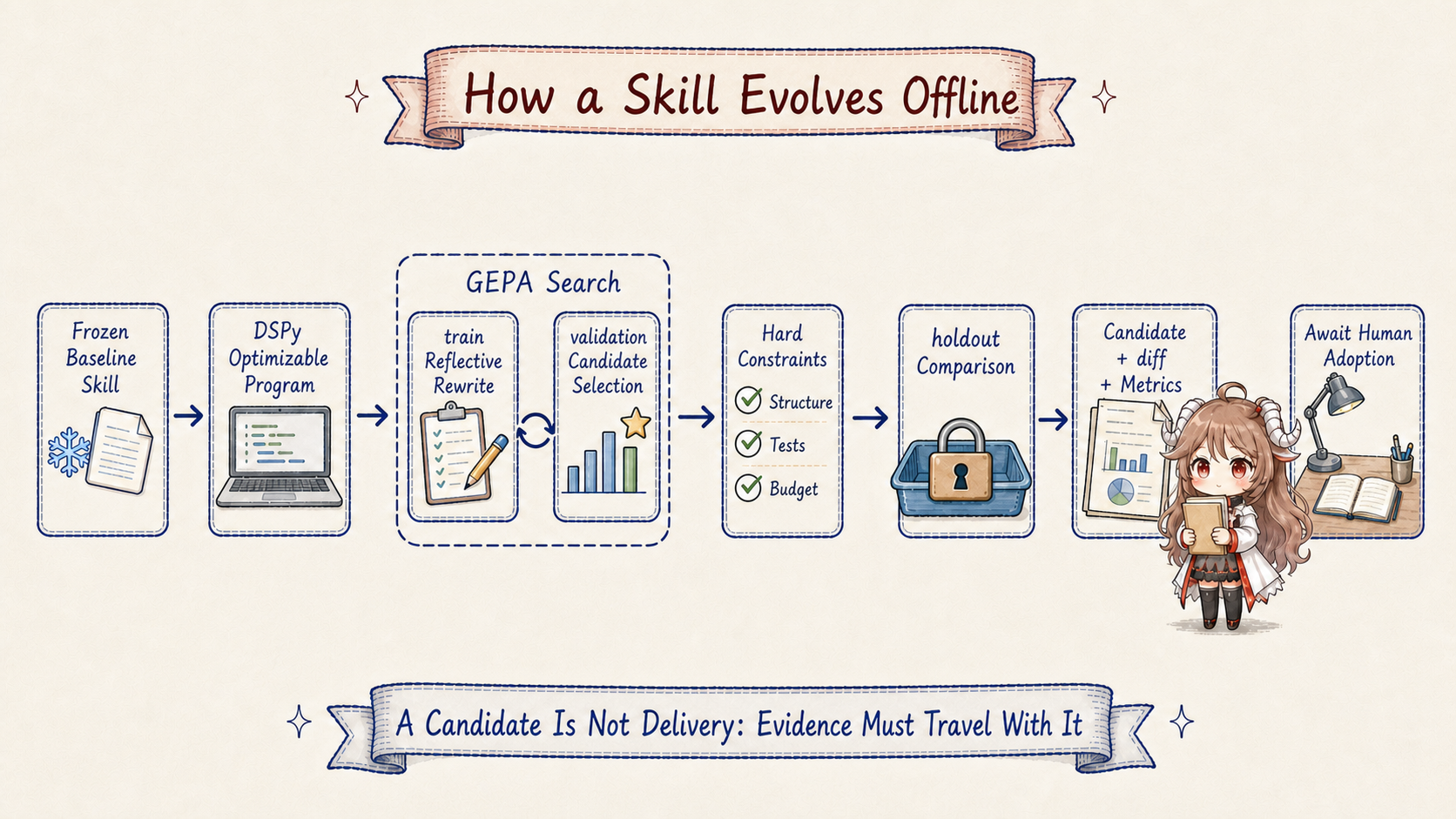
train supplies rewrite evidence, validation steers candidate search, and holdout compares the frozen baseline
with the final candidate only after search stops. It now seems that one command should be enough: hand the Skill
to an optimizer and ask for a better version.
An optimizer does not receive a blank page, though. One Agent run contains the user's task, Skill instructions, tool-control flow, model output, and scoring rule. If all of that is assembled as one temporary string, an evaluator can report a failure but cannot answer two basic questions: which text may change, and how is the selected text installed back into the program?
Keep following the same example. The old Skill already says to regenerate code after a schema change and then run tests, but the Agent still forgets to inspect the generated diff. We want the optimizer to change that working instruction. It must not change the user's schema, rewrite Python control flow, or quietly edit the rubric to make the score easier. Search therefore needs four categories before it begins:
Fixed inputs and outputs: a task enters and a result leaves
Fixed execution structure: how the program calls models and tools
Searchable parameter: the Skill instruction for doing the task
Fixed evaluator: how the same task produces a score and failure reason
Each category fixes a different part of the experiment. The first two keep every candidate on the same job, the third names where change is allowed, and the fourth keeps old and new versions under the same ruler. If the program does not explicitly expose the third category, an optimizer may tune a surrounding prompt while the Skill body never changes. If the evaluator moves with the candidate, a higher score is no longer comparable.
This chapter follows one process that can be checked step by step. How the old Skill becomes an optimizable parameter; how a failure becomes a new instruction; how that candidate is rerun and selected; how winning text returns to a file; and how constraints, holdout, and human review decide adoption. A step that exists only in a README, class name, or comment is not connected.
The previous chapter already explains tasks, rubrics, and the permissions of the three data splits, so this chapter recalls them only when the execution requires it. We will first use DSPy to separate program structure from searchable parameters, then follow GEPA from trace and feedback to rewritten text, and finally audit the latest fixed Hermes Agent Self-Evolution snapshot against that target flow.
2. Before GEPA, identify what DSPy makes optimizable
We now have tasks and a ruler, but one interface is still missing: what is the optimizer allowed to change? If an application concatenates one long prompt string and sends it directly to a model, a low score does not tell an optimizer which text contains the task instructions, which text is runtime input, or how a revision should be installed back into the program.
DSPy addresses that middle layer. It is not one search algorithm. It is an LM programming framework: declare inputs, outputs, and task instructions; compose one or more calls into a module; then pass the program, examples, and metric to an optimizer. Prompt writing becomes compilation of a parameterized program.
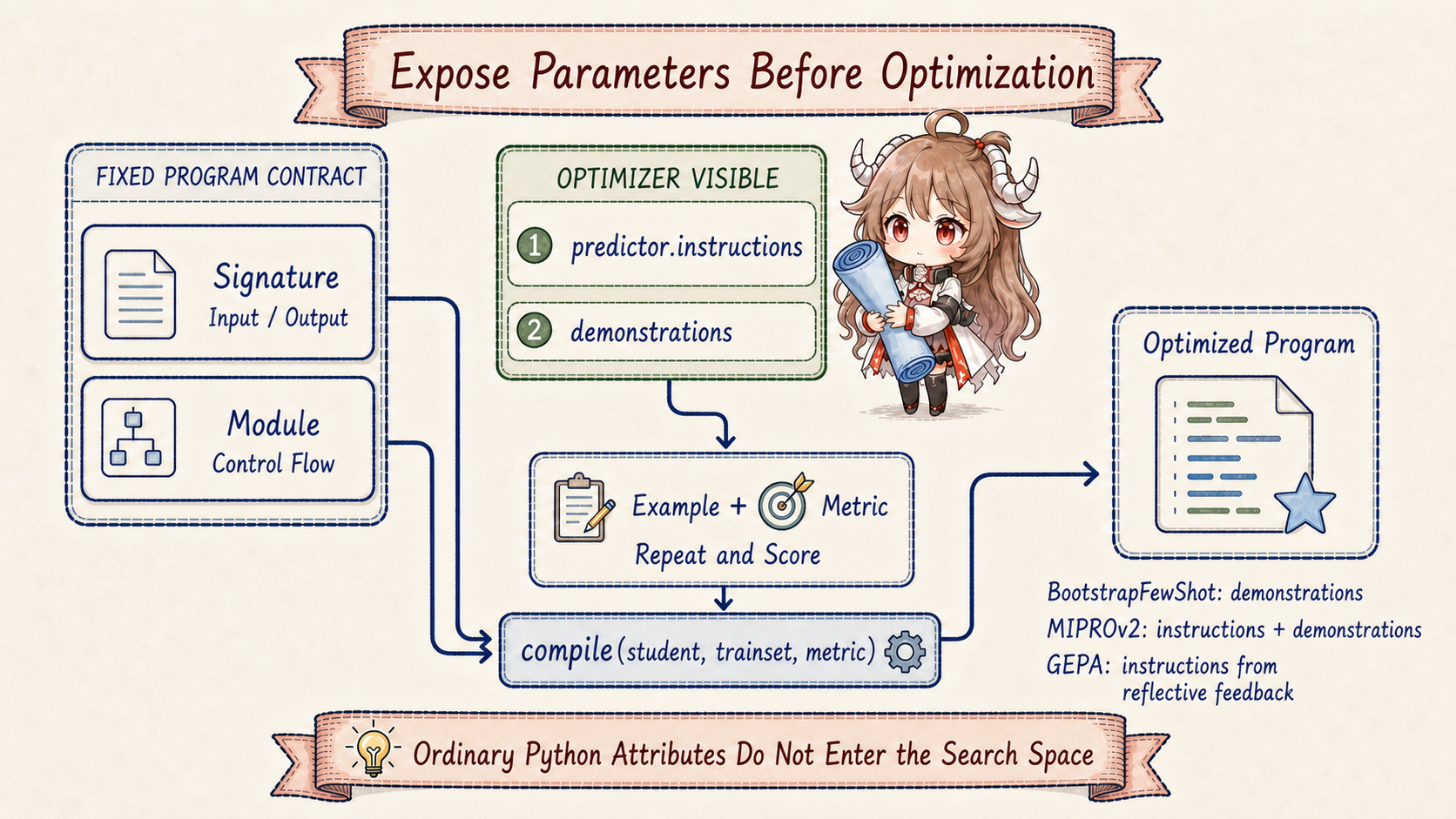
Before reading class names, divide the program into four boxes. The first two define how the program works, the third is what an optimizer may search, and the last only judges results:
fixed input and output fields: Signature
fixed execution structure: Module
searchable content: explicitly registered instructions / demonstrations
candidate judgment: Example + metric
For the ordinary predictor path introduced here, DSPy does not rewrite arbitrary Python control flow or
automatically treat every string as an optimizable parameter. Exposed instructions and demonstrations enter
search; input fields, Module control flow, and the metric remain developer-owned. Explicit dspy.Flex
submodules can also expose their source as search components. Section 4.2 separates that path from the current Hermes wrapper.
2.1 Put the generated-code task into DSPy
Keep the generated-code-testing Skill as the running example. The program should receive a schema
change and repository state, return a verified repair, and allow an optimizer to replace the instruction that
describes how generated code must be checked. That requires separate places
for input and output, execution, evaluation cases, and scoring. DSPy assigns one object to each job.
Start with a Signature, the form for one language-model call. Its input field contains the schema
change and failure scene, its output contains the repair and verification, and its instructions say "run the
real generator, inspect the generated diff, then run the target tests." To optimize the Skill, an adapter
must place that text in replaceable instructions rather
than pass it as an ordinary input beside the code.
A Module decides how to execute the form, for example with one ChainOfThought
predictor. The "schema changed but generated files are stale" task becomes an Example: repository
state fills the input field and the scoring
note stays with the case. Finally, a metric reads the result and the note to return a score;
reflective optimizers such as GEPA can also consume textual feedback. Together these four objects tell an
optimizer both which instruction may change and how to compare the result.
current skill
-> Signature.instructions
-> replaceable instructions

evaluation task -> Example
Module -> run one generated-code repair
metric
-> score and failure reason
compile -> revised program
The table can now compress the four source names without asking the reader to infer their order:
| Role | In the generated-code example | Responsibility |
|---|---|---|
Signature | Schema state is input, repair evidence is output, and instructions carry the Skill | Declare fields and the replaceable instruction |
Module | ChainOfThought runs that Signature | Fix call structure and control flow |
Example | One generated-code failure and its rubric | Provide a repeatable comparison |
metric | Check regeneration, diff inspection, and the selected tests | Define what “better” means |
The crucial question is parameter visibility. DSPy stores task instructions on
Signature.instructions, and optimizers walk a Module's predictor tree to find parameters.
Official source distinguishes predictor objects that are discoverable Parameters from plain
Python attributes, which are not exposed automatically. See the
Signature instruction behavior
and
Module discovery rules.
compile() is therefore not a magic call that makes a model smarter. It accepts an explicitly
structured student program, training examples, and a metric, then returns a copy with selected or revised
prompt parameters. Model weights can remain unchanged. This gives us the right source-review question for
Hermes: is the skill body a predictor instruction, or merely an input value?
2.2 The three optimizers do not change the same thing
The framework lets us choose a method by asking what the failure can teach. Start with the simplest case:
the old skill is broadly correct, but the model lacks successful patterns to imitate.
BootstrapFewShot runs training examples, keeps traces that satisfy the metric, and installs them
as demonstrations on predictors. It mainly adds examples rather than systematically rewriting the task instruction.
When both the examples and the wording may be weak, MIPROv2 expands the search. It proposes
multiple instruction and few-shot candidates, then uses validation scores to search their combinations.
It can change both what the program says and which examples it shows, at the cost of evaluating more combinations.
When the run also preserves a failure scene such as "ran the generator but never inspected its diff," GEPA can
read the trace and textual feedback, explain the failure, and revise predictor instructions. All three
methods consume a DSPy program and evaluation data, but they change different parameters and learn from
different signals. The table is now a compact replay:
| Optimizer | Primary change | How evaluation guides it |
|---|---|---|
BootstrapFewShot | Select and insert demonstrations | Keep successful traces that satisfy the metric |
MIPROv2 | Combine candidate instructions and demonstrations | Propose candidates, then search combinations by validation score |
GEPA | Rewrite predictor instructions | Read traces and textual feedback, reflect on failures, and propose revisions |
The official BootstrapFewShot implementation installs qualified traces as predictor demos;
MIPROv2 proposes both instruction and few-shot candidates before searching their combinations.
See
BootstrapFewShot
and
MIPROv2 candidate generation.
GEPA also changes instructions, but it asks an LM to read failure evidence before writing the next one.
We can now explain why that difference matters.
3. GEPA's key move is changing prompts with the reason for failure
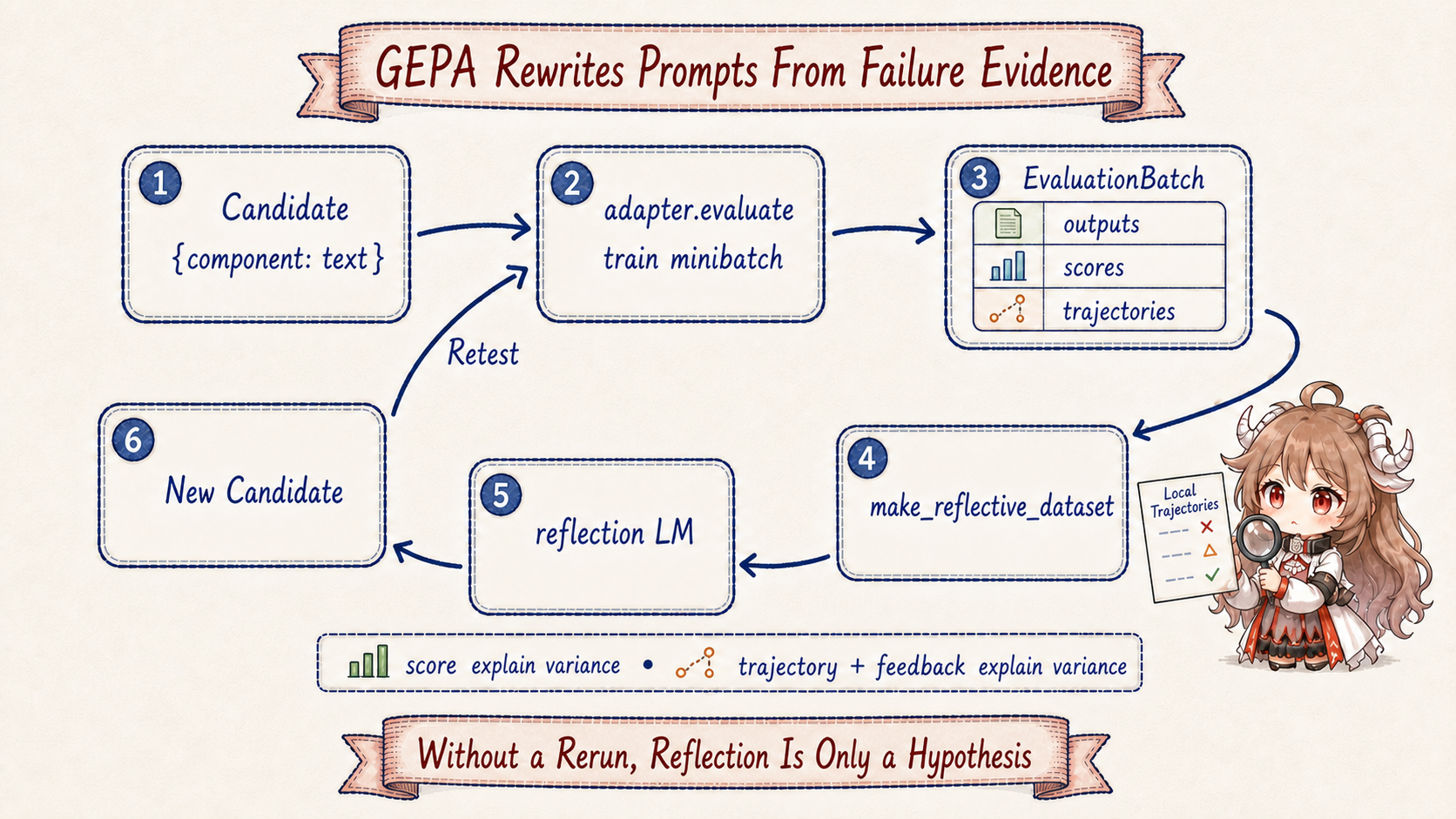
Only now do we need GEPA. The paper keeps model weights frozen and searches over natural-language prompts. Each iteration selects a parent candidate, runs it on a minibatch, collects traces, scores, and textual feedback, then asks a reflection model to diagnose failures and propose a new prompt. Evaluated candidates return to the pool and the loop continues.
Keep the generated-code task in view. One reflective step is not free-form self-critique; it is a chain that can be executed again:
candidate P1 handles a test failure after a schema change
-> it runs the generator but never inspects the generated diff, so it scores poorly
-> feedback says the run cannot distinguish expected schema output from accidental files
-> the reflector adds an explicit "inspect the diff after generation" step
-> candidate P2 is produced
-> P1 and P2 rerun the same small task batch
-> only measured improvements return to the candidate pool
Read the next figure as "execute, diagnose, revise, retest." Textual feedback proposes a direction; another execution proves whether the revision helped. Without that final step, reflection is only a plausible explanation.
3.1 Traces turn "wrong" into "wrong at this step"
A score of 0.4 does not reveal whether a failure came from tool choice, ordering, a missed constraint, or output format. A trace exposes intermediate decisions. Textual feedback can add, for example, "the correct tool was called, but the agent did not use the fallback after an empty result." GEPA's reflective mutation reads that context and targets the failure mode. The algorithm and feedback interface are described in Section 3 of GEPA v2.
In the standalone GEPA implementation, this failure scene is not an arbitrary log blob. The adapter must return outputs and scores at their original example positions and associate captured trajectories with their tasks. GEPA leaves trajectory contents opaque and asks the integration to interpret them. That separation lets the engine optimize agents, RAG pipelines, or other text components without understanding each runtime.
Candidate = dict[str, str]

@dataclass
class EvaluationBatch:
    outputs: list[RolloutOutput]
    scores: list[float]
    trajectories: list[Trajectory] | None = None

def evaluate(
    batch,
    candidate: Candidate,
    capture_traces: bool = False,
) -> EvaluationBatch: ...
In
EvaluationBatch,
scores[i] says how well task i went; make_reflective_dataset later turns captured
traces into actionable feedback. Do not assume every adapter places task i at trajectories[i]: the current
ordinary DSPy predictor path can drop traces for tasks that raised, while restoring outputs and scores by
example_ind. Missing positions receive None and failure_score.
input tasks: [A, B, C]; B raises during execution
outputs: [A output, None, C output]
scores:  [A score, failure_score, C score]
captured trajectories: A, C (records retain their task and example_ind)
This shape-level example shows why failures must not disappear from the score table: otherwise C's score
could be attributed to B. See
DspyAdapter.evaluate.
Validation evaluation can omit traces, while reflective training evaluation needs them. Having a score and
having a failure scene are separate conditions.
3.2 Why not mutate the overall winner forever?
One candidate may detect stale generation, another may catch generated files that should not be committed, and a third may choose the right test scope. Keeping only the highest average score can discard those local strengths too early. By default, GEPA tracks a Pareto set based on per-example performance: it samples an example, then chooses among candidates that are strong on that example. Specialized candidates can remain parents instead of being erased by one temporary champion.
That is why Pareto appears in the name. It protects search diversity under a limited rollout budget. The paper's ablation finds that always mutating the current best is weaker than Pareto selection. It also notes that merging candidates is not always beneficial when prompt components depend on each other.
If correctness and execution cost need separate visibility, a DSPy metric can also return
objective_scores, which the adapter passes to GEPA. GEPA can explicitly track frontiers by
objective or combinations of examples and objectives. The default remains per-example tracking: adding objective
scores does not activate another selection strategy or enforce a hard budget. See the
score and objective fields and
frontier_type.
4. Walk one complete evolution before tracing framework wiring
We have now met the baseline, evaluation example, rollout, trace, candidate, DSPy, and GEPA. Recognizing the pieces is not the same as connecting the process. Keep the same generated-code Skill and replay how an old version becomes a deliverable version. Only then inspect how three frameworks pass data along that route.
4.1 How an old version becomes a deliverable candidate
- Freeze the starting point. Preserve the old skill, model configuration, task sources, and data split. The baseline must not move as candidates accumulate.
- Run the baseline. Execute the old version on training and validation tasks. Preserve each output, trace, score, and feedback so the system knows both how well it performs and where it fails.
- Propose a candidate. The optimizer selects a parent and a minibatch of failures. A reflection model reads the skill, traces, and feedback, then writes a targeted revision.
- Execute again. The candidate faces the same tasks. A structure, size, or safety violation rejects it immediately; only valid candidates reach score comparison.
- Continue the search. Validation scores and per-example strengths decide which candidates remain and which one becomes the next parent. The loop stops when budget expires or improvement stalls.
- Open holdout once. Only after selecting a candidate do old and new versions face tasks hidden throughout search. No stable improvement means no delivery.
- Hand the evidence to a person. Show the skill diff, baseline and candidate metrics, failed examples, and known limits. A reviewer may accept, reject, or revise it; the optimizer never overwrites the live skill directly.
The route contains three identities. The old version is the comparison point. A candidate is an unproven experiment. A delivered version earns that status only after holdout comparison and human review. Producing better-looking prose completes step three, not self-evolution.
4.2 Adapters translate three representations
With the route visible, framework wiring becomes easier to read. Hermes owns a skill file. DSPy wants a repeatable program whose optimizable text lives in predictor instructions. GEPA sees named text components plus an interface that executes them and returns per-example scores and traces. These are different data shapes, so an adapter has to translate between them.
GEPA's independent
official implementation
sends candidates to an adapter and receives scores, traces, and reflection material. It does not inherently
know about DSPy Signatures or a Hermes SKILL.md. dspy.GEPA handles the DSPy side:
it walks student predictors, turns pred.signature.instructions into seed components, runs the
module with trace capture, and installs selected text into a new program. See
dspy.GEPA.compile
and the standalone
GEPA adapter interface.
Without Flex submodules, DSPy's translation can be reduced to the following sketch. The first step defines the search space:
predictor signature.instructions become seed components. The adapter turns candidates into traces and
scores, GEPA performs the search, and the adapter installs the winning text back into a program.
seed_candidate = {
    name: pred.signature.instructions
    for name, pred in student.named_predictors()
}
result = optimize(seed_candidate=seed_candidate, adapter=adapter, ...)
new_program = adapter.build_program(result.best_candidate)
This excerpt from
dspy.GEPA.compile
gives us a concrete audit rule: to prove that text evolves, identify where it enters
seed_candidate and where the corresponding best_candidate text is written back.
The adapter determines what actually evolves.
Standalone GEPA can optimize arbitrary text through a custom adapter. Ordinary predictors
seed candidates from instructions; explicit Flex submodules contribute code from module_src. A skill body supplied as a normal input does not
become an optimizable parameter merely because it participates in the same forward call.
Flex does not discover and rewrite arbitrary Python attributes. compile explicitly enumerates
Flex submodules and adds their module_src to the candidate; build_program rebinds the
winning code to those submodules. A separate code_proposer can now rewrite these code components,
while ordinary predictors still use the instruction proposer. See
candidate construction and write-back and
component routing and program reconstruction.
Hermes's SkillModule uses ordinary ChainOfThought and has no Flex submodule, so this
capability does not supply its missing Skill-body mapping.
The adapter and engine also share responsibility for batch evaluation and resume. When several proposals
need evaluation, DSPy divides the total num_threads budget across candidates and their tasks,
and saves the adapter RNG state; each candidate does not receive a fresh full thread budget. Resuming GEPA
from an existing run directory reuses saved seed scores instead of paying for them again. A new seed absent
from the saved pool is evaluated on validation before being added. See
thread allocation and RNG state,
state resume, and
new-seed ingestion.
These mechanisms reduce repeated work. They do not replace fixed model, data, and metric configurations,
or demonstrate that Hermes has enabled resume.
4.3 How the Hermes entry point expresses the target route
The Hermes CLI lays out ten intended stages: find a skill, prepare data, validate the baseline, configure
DSPy, run GEPA, extract a revision, validate constraints, compare on holdout, report, and save. The main
entry point is
evolve_skill.py.
To make one skill repeatable on one task, SkillModule wraps it as a DSPy module. Each forward
call supplies the skill body and task input to a ChainOfThought predictor and returns the model
output. In plain terms, it turns "this skill performs this task" into a function that can be rerun, scored,
and compared. See
SkillModule.
class TaskWithSkill(dspy.Signature):
    skill_instructions: str = dspy.InputField()
    task_input: str = dspy.InputField()
    output: str = dspy.OutputField()

def __init__(self, skill_text):
    self.skill_text = skill_text
    self.predictor = dspy.ChainOfThought(self.TaskWithSkill)

def forward(self, task_input):
    return self.predictor(
        skill_instructions=self.skill_text,
        task_input=task_input,
    )
This wrapper already makes execution repeatable, but it also exposes the problem the next section audits:
self.predictor is a predictor DSPy can discover, while self.skill_text is an ordinary
Python attribute that forward supplies through an InputField. Participating in one execution does
not automatically place text in the seed_candidate.
| Required stage | Evidence to preserve | Correct failure behavior |
|---|---|---|
| Freeze baseline | Original skill, source version, model configuration | Do not silently move the baseline |
| Prepare evaluation | Task sources, rubrics, split, and seed | Stop if the ruler is not credible |
| Reflect and mutate | Parent, examples, traces, feedback, and proposal | Keep enough context to explain regressions |
| Gate candidates | Structure, size, tests, and benchmark results | Reject any hard-constraint failure |
| Compare holdout | Baseline and candidate on the same unseen set | Do not deliver without improvement |
| Human delivery | Diff, metrics, limitations, and rollback version | Never overwrite a live skill directly |
This table compresses the route from section 4.1 into a source-review ruler. A repository can contain a class for every stage without moving values through a process that can be verified. "Implemented" is a statement about actual parameters, return values, checks, and delivery, not about filenames.
5. How far the current source goes: a prototype with key steps still disconnected
When returning to the Hermes repository, separate "a file exists," "it enters the main path," and "the target loop is demonstrated." The fixed snapshot first divides into three states:
| Status | What the current source supports |
|---|---|
| In the main path | Read a skill, choose one data source, build DSPy examples, and attempt optimization; holdout comparison and successful output require the candidate constraints to pass |
| Code exists but is not wired into the target path | The richer LLM judge, test runner, and PR configuration do not decide which candidates can continue to search and delivery |
| Target route not demonstrated | GEPA actually rewrites the skill body, every candidate passes hard checks, and an accepted result becomes a reviewable PR |
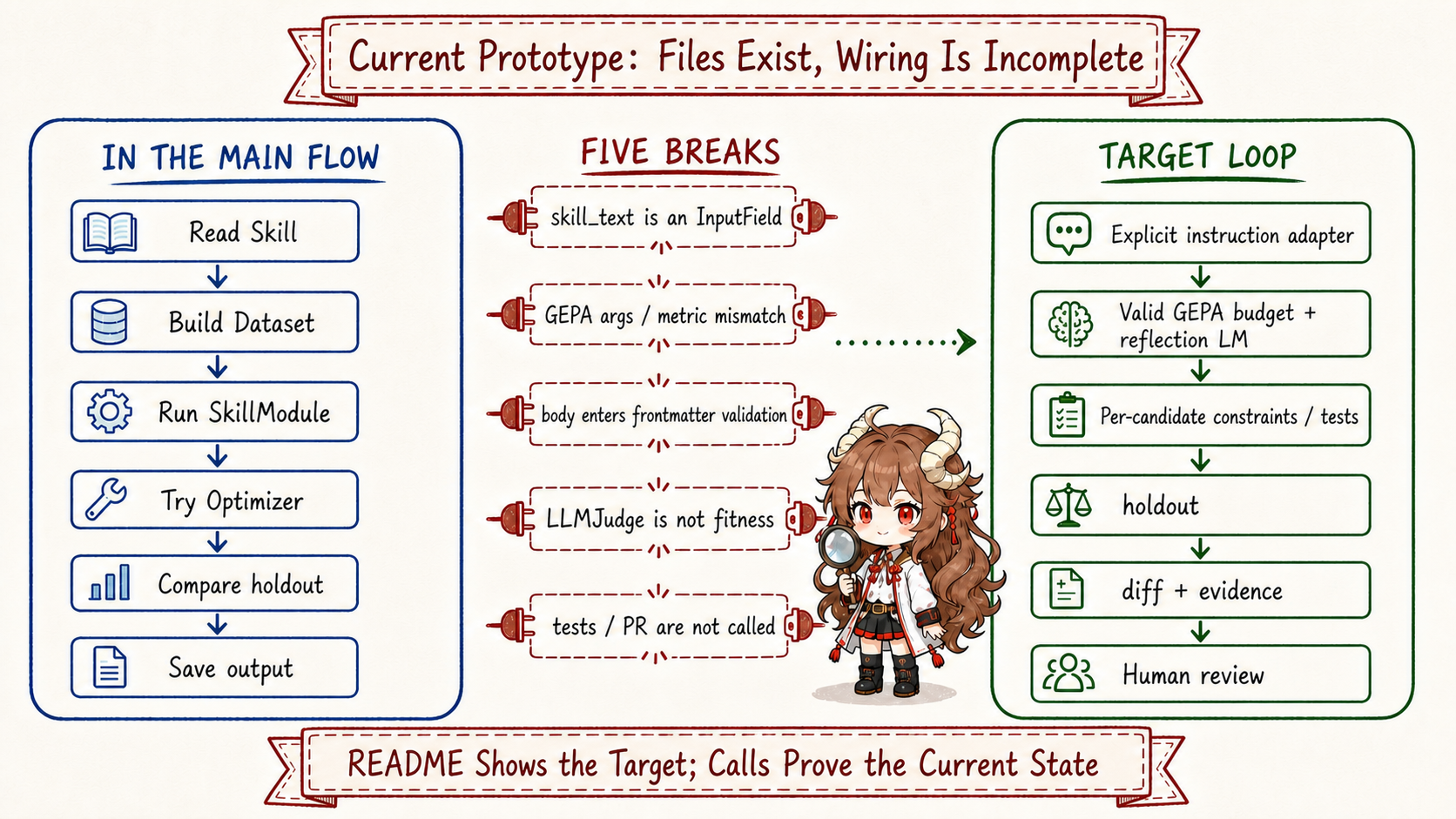
Start with what exists. The repository can discover and parse skills, generate or import evaluation data, construct a DSPy module, invoke an optimizer, compare baseline and candidate on holdout, and save metrics with before-and-after artifacts. That is a real orchestration and data skeleton with unit tests around several components.
At fixed snapshot 0a929e3, however, several connections prevent it from being an end-to-end delivery loop.
5.1 The skill text is not clearly registered as a GEPA prompt parameter
SkillModule stores the body in an ordinary Python attribute, self.skill_text, then
supplies it as the skill_instructions input field during forward. The orchestration later
assumes optimized_module.skill_text contains a GEPA rewrite. The current source does not show a
bridge that registers this plain attribute as a DSPy prompt parameter. From this call path alone, we
cannot establish that GEPA rewrites the skill itself rather than predictor prompt state.
baseline_module = SkillModule(skill["body"])
optimized_module = optimizer.compile(baseline_module, ...)

# The orchestration reads the "evolved body" from a plain attribute.
evolved_body = optimized_module.skill_text
What is missing is a two-way mapping, not one assignment. Before optimization, the skill body must become
predictor instructions; afterward, the winning instructions must become a SKILL.md body again.
The current
orchestration
shows wrapping and extraction but not either translation.
5.2 An unbounded dependency does not match the GEPA constructor
The repository declares dspy>=3.0.0 without an upper bound, while the orchestration calls
dspy.GEPA(metric=skill_fitness_metric, max_steps=iterations). In the latest DSPy snapshot fixed
for this chapter, GEPA has no max_steps. It requires exactly one of auto,
max_full_evals, or max_metric_calls, plus either a reflection_lm or a
custom instruction_proposer. Compare the
Hermes dependency,
call site, and
latest DSPy constructor.
# Hermes call site
dspy.GEPA(
    metric=skill_fitness_metric,
    max_steps=iterations,
)

# Relevant parameters in the latest DSPy snapshot
def __init__(
    metric,
    *,
    auto=None,
    max_full_evals=None,
    max_metric_calls=None,
    reflection_lm=None,
    instruction_proposer=None,
): ...
This is more than a renamed parameter. Exactly one budget option must be selected, and either a reflection model or proposer must be present. The current call supplies neither a valid budget nor the component that should read failures and propose new instructions.
Hermes also supplies a three-argument metric, while the latest DSPy constructor checks an interface with
five values: gold, prediction, full trace, predictor name, and predictor trace.
The configured optimizer_model is printed but never passed as GEPA's reflection LM. Under the
latest dependency snapshot used here, the GEPA path therefore fails before reflection begins; the broad
exception handler then switches execution to MIPROv2.
5.3 Structure validation receives a body but requires frontmatter
load_skill separates frontmatter from the body. The main flow passes skill["body"]
and evolved_body into validate_all. Yet _check_skill_structure requires
its input to begin with --- and contain name: and description: near the
start. That condition necessarily fails for the current caller. See
validate_all
and
_check_skill_structure.
# The caller supplies only the body.
validator.validate_all(skill["body"], "skill")
validator.validate_all(evolved_body, "skill", ...)

# The validator checks for a complete file.
has_frontmatter = text.strip().startswith("---")
has_name = "name:" in text[:500] if has_frontmatter else False
has_description = "description:" in text[:500] if has_frontmatter else False
Baseline and candidate therefore fail at the same check even when both bodies are valid. A repair must either validate the reassembled full skill or give body constraints and frontmatter constraints their own inputs, instead of asking one function to guess which layer it received.
5.4 A rich LLM judge exists, but optimization receives keyword overlap
fitness.py defines an LLMJudge with correctness, procedure following,
conciseness, and textual feedback. That resembles the explanatory feedback GEPA can use. The function
actually passed to dspy.GEPA(metric=...), however, computes word overlap between expected
behavior and output and returns one float. Compare
LLMJudge
with
skill_fitness_metric.
expected_words = set(expected.lower().split())
output_words = set(agent_output.lower().split())

overlap = len(expected_words & output_words) / len(expected_words)
score = 0.3 + (0.7 * overlap)
return min(1.0, max(0.0, score))
These lines are the objective the search actually sees. The proxy is fast, but it rewards repeating rubric vocabulary rather than necessarily completing the task. It also does not return the rich failure explanation through this metric path. That is an interface gap between the current search objective and the paper's reflective method, not a small matter of adjusting weights.
5.5 Tests, per-candidate checks, and PR delivery remain disconnected
ConstraintValidator contains run_test_suite, and configuration includes
run_pytest and create_pr. The main flow does not call the test function and does not
create a PR. Constraints run only after compilation on the final extracted body; they do not check every
candidate entering GEPA's pool. The success path writes files and metrics.json under
output/. See
run_test_suite
and the
output stage.
5.6 Broad fallback conflates unavailable GEPA with a failed GEPA run
The main flow catches any Exception from GEPA compilation and falls back to MIPROv2. That makes
a demonstration more likely to continue, but it can relabel a real integration error as "GEPA not
available." A rigorous run should fall back only for an explicit capability check and preserve all other failures.
This does not make the repository valueless. Session import, sample structure, skill wrapping, holdout comparison, and constraint classes form a useful base. The accurate status is narrower: a Phase 1 prototype exists, while end-to-end GEPA skill rewriting, hard gating, and reviewed delivery are not established by the current call path.
6. How to read “39.5% improvement”: ask what the experiment changed
The Phase 1 report describes one arxiv-skill experiment using MiniMax M2.5. Seven synthetic examples
yielded three training and two validation examples. The optimizer was DSPy BootstrapFewShot and the metric
was keyword overlap. Validation example one moved from 0.408 to 0.569, reported as +39.5%; example two
stayed at 0.374. The average moved from 0.391 to 0.472, or +20.7%. Configuration and results appear in
generate_report.py.
This was not a GEPA experiment, and it did not rewrite the skill. BootstrapFewShot selected strong execution traces as demonstrations and augmented the module. The supported conclusion is correspondingly narrow: on a tiny synthetic set and proxy metric, a DSPy-wrapped module scored higher after demonstration augmentation. It does not prove that GEPA is wired, or that a rewritten Hermes skill improves real tasks.
| Evidence | What it tests | What it cannot establish |
|---|---|---|
| GEPA paper | Prompt evolution and ablations across six task families | The Hermes integration gets the same gains |
| Phase 1 report | One skill, tiny synthetic set, BootstrapFewShot, keyword metric | GEPA ran or rewrote the skill body |
| Current source | Data, orchestration, comparison, and constraint prototypes | Tests, PRs, and per-candidate checks are connected automatically |
The GEPA paper reports stronger evidence for the method itself: across six tasks, roughly 6% average and up to 20% improvement over GRPO, with up to 35 times fewer rollouts, plus more than 10% average improvement over MIPROv2. Those numbers make the method worth studying. Their evaluation target is the paper's benchmarks, not this Hermes prototype. Separating the layers makes the project's next work clearer.
7. What remains before the prototype can produce a credible Skill
The path forward does not need more terminology. It needs tasks, results, and checks to pass through every step:
- Freeze the artifact. Record source commit, skill hash, model, and dataset configuration so the baseline can be replayed.
- Make the skill a real optimizable prompt parameter. Use DSPy's supported instruction or signature mechanism instead of relying on an ordinary attribute to mutate implicitly.
- Return the right objective. Prefer executable checks; use rubric judges for open tasks and pass actionable textual feedback into GEPA.
- Check every candidate first. Validate full frontmatter, size growth, tests, and caching behavior before a candidate enters the pool.
- Keep failures in the right layer. Do not let a different optimizer hide a failed GEPA integration; fallback should be an explicit run mode.
- Open holdout once. Report per-example outcomes, regressions on critical old tasks, and repeated runs or uncertainty, not only a percentage from one example.
- Account for the cost of improvement. A higher score cannot depend on unacceptable model cost, tokens, tool calls, or latency; report those budgets beside the baseline.
- Deliver a diff, not an overwrite. Package candidate, baseline, metrics, failures, and a PR for human approval.
- Wait for a future session. A passed skill should take effect in a new session or at an explicit refresh point, not mutate the stable prompt prefix halfway through a conversation.
stable improvement on unseen tasks
+ no regression on critical old capabilities
+ cost and latency remain within budget
+ data, configuration, and candidate can be replayed
+ the old version can be restored
= eligible for a human delivery decision
Those steps close the offline search portion. Runtime use discovers experience worth preserving; offline evaluation treats a Skill as a versioned artifact and returns an approved revision for future sessions. New failures become evidence for the next cycle instead of immediate self-rewrites. The next chapter follows the remaining handoff: how Hermes gathers local verification evidence before a candidate reaches human review, and how it avoids ending a changed-code task without fresh passing evidence.
8. Conclusion: self-evolution strengthens evidence, not just text
Return to the opening question. Writing "run the generator first" into a skill does not establish an improvement. The revision earns that name only when old and new versions face the same independent tasks, the new one performs better on the right objective, and it preserves structure, tests, and runtime stability.
Runtime discovers experience.
Evaluation fixes the question.
Traces and feedback
explain failure.
Candidate pools
preserve different strengths.
Constraints and holdout
block self-persuasion.
Human review decides delivery.
Hermes Agent provides the first clock: how experience can enter durable state after turn finalization. GEPA provides a method for the second: evolve prompt candidates through execution, reflection, and selection without updating model weights. Hermes Agent Self-Evolution puts the engineering interface between them on the table. Its current value is not that self-evolution is finished, but that the source makes the next gap inspectable.
Source and paper references
- Fixed NousResearch/hermes-agent-self-evolution source snapshot
- Project README and phase status
- Phase 1 goals, data strategy, and completion gates
- EvalExample, splits, and synthetic generation
- Session relevance filtering and external dataset construction
- SkillModule
- Skill evolution orchestration
- LLM judge and active fitness metric
- Constraints and test-suite function
- Phase 1 experiment configuration, results, and safety claims
- DSPy: Compiling Declarative Language Model Calls into Self-Improving Pipelines
- Fixed official DSPy implementation snapshot
- Latest DSPy snapshot GEPA constructor
- GEPA: Reflective Prompt Evolution Can Outperform Reinforcement Learning
- GEPA v2 paper PDF
- Fixed official GEPA implementation snapshot
- GEPA adapter, EvaluationBatch, and reflection-data interfaces