1. Start with an expense assistant that has only a Model and Tools
The first version of an internal expense assistant is easy to demo. Give a model instructions plus three functions: read an invoice, look up policy, and write a decision. One user uploads a file, the model checks the amount, and the demo appears to work.
The second user exposes the missing system. Their histories mix. A high-value write reaches the expense database without manager approval. A browser refresh loses progress. A service restart writes the same invoice twice. The model can reason and the tools can run, but the product still lacks a stable way to operate.
2. What an Agent framework is
An agent framework turns the shared runtime responsibilities needed to let a model reason repeatedly, call tools, and finish work safely into reusable components and rules. It does not think for the model or choose company policy. It makes reasoning and action continuous, governable, and recoverable.
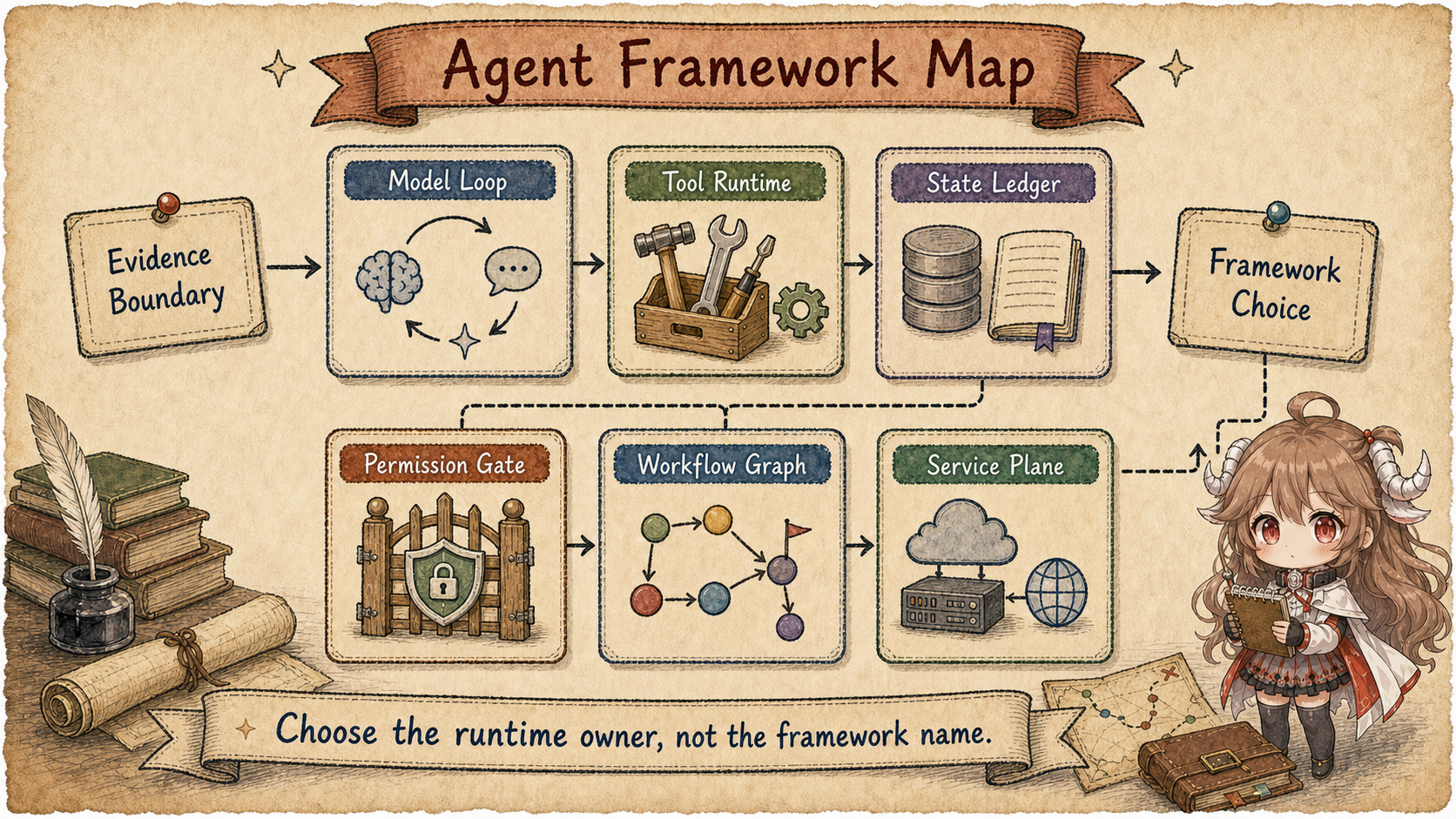
Ignore framework names for a moment. The expense assistant gradually needs six responsibilities:
- Advance the task: decide whether a model answer ends the run or requests another tool step.
- Execute tools: validate arguments before touching files, databases, or remote services.
- Keep progress: preserve users, messages, tool results, and task state for the next turn.
- Stop risky effects: allow harmless reads while pausing high-value writes for approval.
- Control the route: run independent checks together, but delay the final write until both finish.
- Connect a product: stream progress to a UI, isolate users, and resume after interruption.
Later sections call these the model loop, tool runtime, state ledger, permission gate, workflow graph, and service plane. For now, understand the problem each one solves; the names can wait.
3. How one expense claim reaches completion
- The product receives the user, invoice, and claim id, then opens that user's session.
- The runtime gives the model the current question, necessary history, and available tools.
- The tool layer validates a file read, returns the amount, records it, and lets the model request policy.
- If the amount crosses a threshold, the permission gate pauses the write and the UI shows an approval wait.
- After approval, the workflow allows the expense write and records the external effect.
- The answer, tool results, and task status persist so a refresh or service restart can resume safely.
This six-step route is the spine of the series. Frameworks differ less by whether a class exists than by which steps they own and which steps they leave to application code.
3.1 Give the Run a durable identity
To keep the six responsibilities from becoming six unrelated vocabularies, the rest of this chapter follows one
record: expense run E-1042. It is not the full chat transcript. It is the application record that answers
where the task is, what may happen next, and where recovery begins. The model, tool runtime, approval UI, and ERP
system see different fields, but all of them return to the same Run identity.
{
  "expense_run_id": "E-1042",
  "applicant": "alice",
  "invoice_ref": "INV-77",
  "amount": null,
  "policy_result": null,
  "pending_action": null,
  "approval": "not_required_yet",
  "idempotency_key": "expense:E-1042:commit",
  "erp_receipt": null,
  "status": "submitted"
}
After the invoice read, the tool layer changes only amount to 12800. The policy check then
records “manager approval required.” The permission gate does not write to ERP; it stores
pending_action=write_expense and a resume key, then advances the record to
waiting_approval. Approval creates a new invocation that still references E-1042 and the
original idempotency key. Only the ERP receipt ERP-778 advances the task to completed.
| Stage | Component changing the record | New fact | Recovery point |
|---|---|---|---|
submitted |
Product entry point | User, invoice reference, task identity | Reload the session by E-1042 |
evaluated |
Tool and workflow layers | Amount and policy result | Continue from recorded facts instead of asking the model to infer them |
waiting_approval |
Permission gate | Pending action, approval summary, resume key | The approval event reattaches to the original action |
completed |
Application and ERP | Idempotent write receipt ERP-778 |
The receipt proves that a retry must not write again |
This separates three kinds of visibility. The persistent record may retain a full Tool result, the next Model call may receive only selected fields, and the approval UI may expose only the amount, reason, and pending action. Persisted does not mean model-visible, and model-visible does not mean authorized.
Questions this article answers. Decide which component handles each runtime responsibility before choosing a framework name. A notebook demo may need only a lightweight agent loop. A product also needs persistent records, permission checks, an event stream, product integration, and a recovery path.
This chapter puts AgentScope, Pi, Google ADK Python, Agno, AutoGen, CrewAI, Eino, and tRPC-Agent-Go on one map. It also keeps OpenAI Agents SDK nearby as a lightweight but important reference point. This is a reading coordinate system, not a benchmark.
Source scope. Product positioning comes from project READMEs and official docs. Source claims point to public repository snapshots. Terms such as runtime route, service layer, and persistent record summarize responsibilities visible in public source; they do not infer private control planes, cloud internals, or model provider implementation details.
This chapter answers five questions:
- What is an agent framework beyond a model plus a few tools?
- Which six responsibilities appear when an agent enters a real product?
- Where do Pi, AgentScope, ADK, Agno, AutoGen, CrewAI, Eino, and tRPC-Agent-Go place their strongest abstractions?
- Why are multi-agent labels and feature counts poor starting points?
- In what order should the next twelve chapters be read?
Four terms recur across the series. Defining them here prevents a common mistake: a record can exist on disk without being visible to the Model, and a framework can assemble one Model input without storing the source record itself.
| Series term | Meaning here | What it is not |
|---|---|---|
| Responsible component (Owner) | The component that defines a responsibility's input and output, state update point, failure handling, and application handoff. | Not merely a directory name, and not necessarily one class. |
| Persistent record (Ledger) | A structured record used for recovery, audit, or continuation: messages, events, entries, or session state. | Not automatically the next model input. |
| Current Model input (Model-visible view) | The content selected and assembled from persistent records, Summary, Memory, and current input immediately before a Model call. | Not a complete copy of stored history. |
| Execution check (Gate) | A decision point that can change execution through allow, deny, pause, route, or resume. | Not only a Boolean validation helper. |
4. Map the six responsibilities to concrete components
A minimal agent demo usually has three parts: instructions, a model client, and tool functions. That is enough for a sample, but not enough for a product runtime. The real problems appear after the first turn: what if a tool result is too large, a user rejects a command, the model emits several tool calls, the web UI needs typed progress events, a background job wakes a session, or a worker agent needs to report back to its leader?
That is why framework comparison should start by separating responsibilities. A responsible component is not merely a directory name. It is where a responsibility gets its input/output shape, state update point, failure boundary, and application handoff.
The rest of the series can be read through one shape-level trace. This is not any framework's exact struct. It is the state movement to keep in view while reading source:
Expense run E-1042: "read INV-77 and submit the claim"
  -> model loop: create an invocation id and select necessary history
  -> tool runtime: turn read_invoice into a schema-validated tool call
  -> permission gate: decide read-only, confirmation required, or denied
  -> state ledger: record amount, tool_call_id, result, and pending_action
  -> workflow graph: route a complete but high-value claim to approval
  -> service plane: send an approval summary and persist a resume key
  -> application: write with expense:E-1042:commit and store ERP-778
Each chapter asks the same questions against that trace: which object receives the input, which check changes the path, which record lets the next turn continue? If an article can only name Agent, Tool, and Memory classes but cannot replay this movement, it has not explained how the framework handles a Run.
| Responsibility | Pressure it solves | If no component handles it |
|---|---|---|
| Model loop | Advances one task through model calls, tool calls, and a final response. | The application writes scattered loops, stop conditions, retries, and streaming handlers. |
| Tool runtime | Registers tools, produces schemas, executes tools, and streams results. | Tools remain plain functions without uniform errors, concurrency, MCP, or compression boundaries. |
| State ledger | Stores messages, events, summaries, memory, sessions, and recoverable records. | UI history, model context, and durable storage drift apart. |
| Permission gate | Controls file writes, shell commands, external tools, and human confirmation. | Every model tool call is either trusted wholesale or blocked wholesale. |
| Workflow graph | Composes deterministic steps, routes, fan-out/fan-in, loops, and agent nodes. | Business logic is stuffed into prompts or scattered through callbacks. |
| Service plane | Handles multi-tenancy, sessions, scheduling, SSE/WebSocket, observability, and control. | The demo runs, but the product surface has to be rebuilt outside the framework. |
5. Put the frameworks on one map
The real difference is not whether a README says agent, workflow, or memory. It is which layer the project makes a first-class abstraction. Some start from workflow graphs, some from multi-agent conversation, some from a service control plane, and some fold tools, permissions, and workspace boundaries into a single agent runtime. The six responsibilities are a checklist, not six mandatory sequential stages.
| Framework | Responsibility to inspect first | Question to ask first | First evidence |
|---|---|---|---|
| AgentScope | Evented agent runtime, permissions, workspace, service sessions. | How does one `reply_stream` become model events, tool events, and recoverable state? | Agent, EventType, PermissionEngine. |
| Pi | A minimal coding-agent harness: provider adapters, agent loop, events, tool batches, and an append-only session tree. | When plans, sub-agents, MCP, and permission prompts stay out of core, which runtime responsibilities must remain stable? | The README separates model access, the agent loop, the coding harness, and terminal UI into four packages. |
| ADK Python | Agent plus graph-based workflow runtime. | When should autonomous agent behavior yield to explicit workflow structure? | The README puts `Agent` and `Workflow` in the quick start. |
| Agno | Agent platform: API, storage, tracing, scheduling, RBAC, control plane. | Which platform concerns should not be stitched together inside business code? | The README says it is for building, running, and managing agent platforms. |
| AutoGen | Multi-agent conversation across AgentChat, Core, and Extensions. | How did multi-agent orchestration evolve from experiments into enterprise runtime needs? | The README is now marked maintenance mode and points to Microsoft Agent Framework. |
| CrewAI | Crews and Flows: role collaboration plus event-driven business flow. | Should a task be handled by autonomous roles or controlled by a deterministic flow? | The README emphasizes both Crews and Flows. |
| Eino | Go-style components, compose graph, and ADK. | Can an agent be one composable node inside a Go service graph? | The README describes Components, ADK, and Composition together. |
| tRPC-Agent-Go | Go agent Runner, GraphAgent, tools, skills, artifacts, servers, and long-context runtime. | After a Go agent becomes a service, who owns invocation boundaries, deterministic workflow, side effects, protocol surfaces, and long-running state? | The README puts agents, graphs, tools, session/memory, skills, and A2A/AG-UI/MCP in one Go-native stack. |
The
OpenAI Agents SDK
is another useful reference. Its core concepts include agents,
tools, handoffs, guardrails, sessions, tracing, and realtime
agents. The current README also gives SandboxAgent its own entry point: when files, commands, and retained workspaces matter, the caller chooses a sandbox client; the README example uses a manifest to declare workspace contents. Lightweight does not imply conversation-only scope. Compare the responsibilities actually handled by Agent, SandboxAgent, and RealtimeAgent.
6. Do not start with Multi-agent
Multi-agent demos are attractive because they are easy to name: planner, researcher, coder, reviewer. But if source reading starts with role names, coordination looks like prompt text. The more durable questions are below that layer: is a handoff a tool call, does the worker have an independent session, which memory is shared, do permissions inherit, how does the result return, and can failure be resumed?
AutoGen matters for exactly this reason. It pushed the community to treat multi-agent conversation, teams, handoffs, and agents as tools as serious abstractions. Its current README, however, says the project is in maintenance mode and recommends Microsoft Agent Framework for new users. This series will read AutoGen as abstraction history and migration context, not as the default starting point for new systems.
In E-1042, a safer decomposition lets every worker update the parent record rather than own the final
side effect. Invoice extraction adds the amount, policy analysis adds the rule result, and approval communication
adds an approve or reject decision. None of those workers may write ERP directly. Only the parent workflow, which
holds the idempotency key and verifies all prerequisites, can submit the claim. Multi-agent decomposition changes analytical
work distribution without distributing permission to write to ERP.
Pi offers a different correction: not every familiar capability belongs in core. It stabilizes providers, the agent loop, tool batches, events, an append-only session tree, and compaction, while leaving plan mode, sub-agents, MCP, remote tools, and permission interaction to extensions. That boundary separates mechanisms the runtime must guarantee from policies a product may choose.
CrewAI, Eino, and tRPC-Agent-Go show three different corrections. CrewAI separates collaborative roles from business flows, so autonomous work and deterministic routing do not collapse into one prompt. Eino takes the Go route: define components and compose graphs first, then place agent patterns inside that composition model. tRPC-Agent-Go continues into a Go service runtime, where Runner, GraphAgent, tools, Skills, artifacts, the server plane, summary, durable memory, and hidden-history recall need separate owners.
7. Reading route: start with the minimal core, then expand the Runtime
Part 2 starts with Pi, not because Pi outranks the other frameworks, but because it draws a clear core boundary. Provider adapters, the agent loop, tool results, events, and sessions must remain stable; plans, sub-agents, MCP, and concrete permission policy can stay in extensions. Once readers know what cannot be removed, later chapters can show exactly which additional responsibilities each framework takes over.
| Reading stop | Question answered here | Question left for the next stop |
|---|---|---|
| Part 2: Pi | How does a minimal agent harness join models, tools, events, and recoverable sessions? | Who owns permission, pause and resume, and service runtime when that core enters a product? |
| Part 3: AgentScope | How does reply_stream join a structured ledger, typed events, a permission gate, and provider adapters? |
Once workspace, storage, and service sessions meet, who owns the agent's real worksite? |
| Part 4: Agent Worksites | Why are Coding / General and Local / Cloud separate axes, and what belongs to Session, Workspace, Artifact, and Memory? | Which protocol should carry those owners across process, service, and client boundaries? |
| Part 5: Agent Protocols | Which boundaries connect tools, remote agents, frontends, and code editors through MCP, A2A, AG-UI, and ACP? | Later protocol support is no longer mistaken for one interchangeable feature category. |
These four stops form the foundation: Pi fixes core, AgentScope expands runtime, the worksite chapter separates deployment from state owners, and the protocol chapter places that runtime at system boundaries. Then ADK's workflow runtime, Agno's platform plane, AutoGen's migration into Microsoft Agent Framework, CrewAI's Crews/Flows, Eino's Go composition, and tRPC-Agent-Go's long-context records can be read by asking which responsibilities each framework handles and which it leaves to the application.
Keep one check in mind for every later chapter: if this layer is removed from the framework, which state, event, permission, and recovery logic must the application rebuild? That question tracks real engineering cost better than a tool count.
8. Keep this decision table nearby
| Your pressure | Capability to compare first | Likely first frameworks to read |
|---|---|---|
| You need a single agent that can call tools quickly. | Model loop, tool schema, sessions. | OpenAI Agents SDK, Pi, AgentScope, ADK. |
| The business process has explicit steps and branches. | Workflow graph, state transition, human gate. | ADK, CrewAI Flows, Eino compose. |
| The agent must become a multi-user product surface. | Service plane, storage, RBAC, tracing, scheduler. | Agno, AgentScope service. |
| The hard part is multi-agent delegation. | Handoff, team protocol, session isolation, result routing. | AgentScope team, CrewAI Crews, AutoGen / Microsoft Agent Framework. |
| The surrounding system is already Go. | Component composition, stream, callback, tool interface, long-context ledger. | Eino, tRPC-Agent-Go. |
8.1 Selection still needs production acceptance tests
For the expense product, finding Session, Workflow, or Approval in a README establishes only a candidate capability.
The team still needs four fixed acceptance cases: Alice and Bob never share records; a service restart while approval
is pending can recover E-1042; repeated submission of the same idempotency key produces one ERP receipt;
and the audit record can reconstruct who approved which action and when.
When a framework does not own one of these responsibilities, the application must own and test it explicitly, or the framework should be rejected for this product. Keep three states separate: the runtime produced an output, acceptance tests validated recovery and side effects, and the product authority adopted the implementation. A class name, demo, or single successful run cannot skip the last two states.
The next chapter enters Pi by following one “change the code and run the tests” task: how the model repeatedly proposes tool calls, how events report progress, how the original conversation remains in a JSONL tree, and why an overlong context is projected again rather than erased.