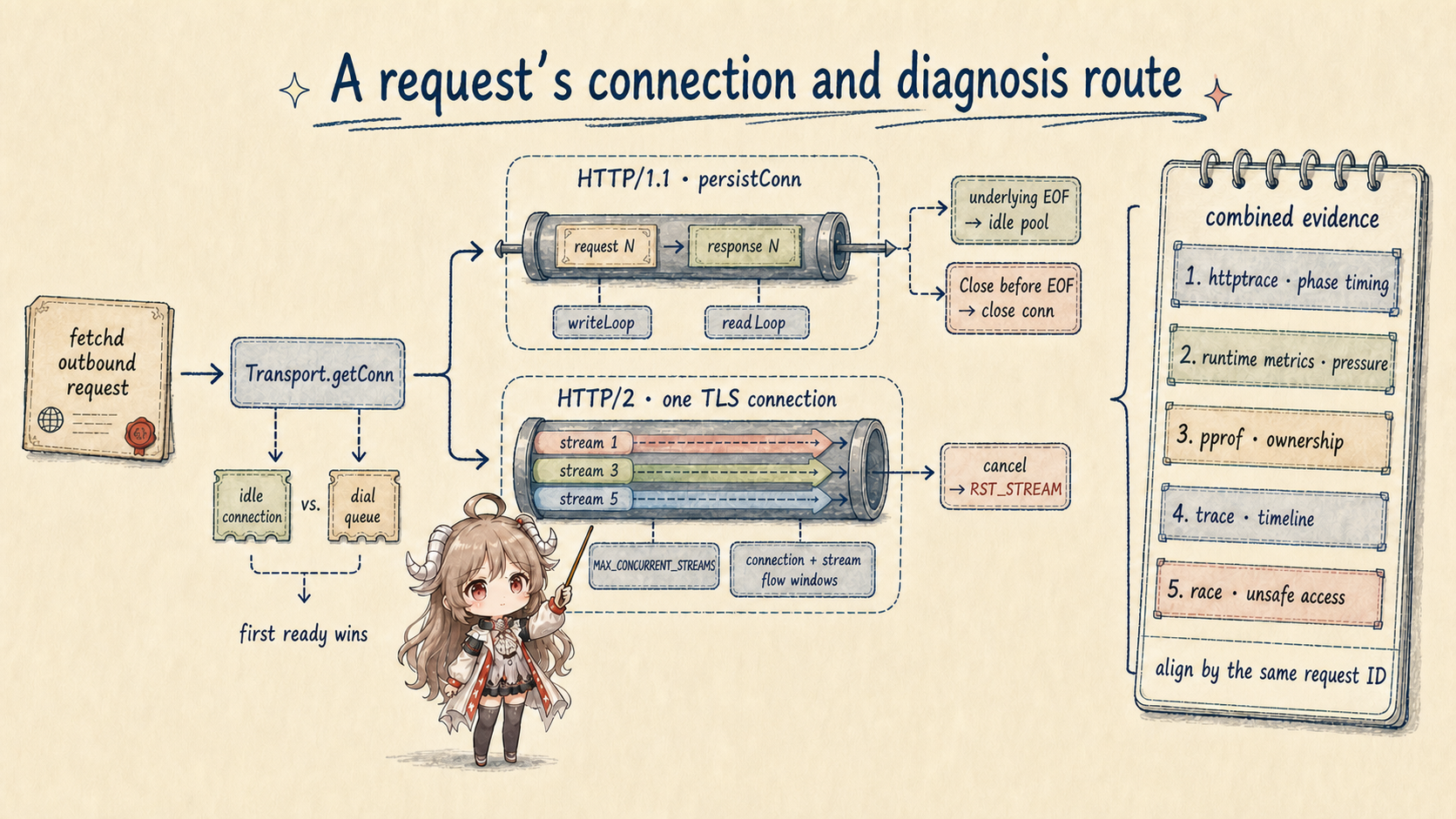
Reading goal: do not memorize connection-pool fields. Learn to distinguish three kinds of waiting: waiting for a usable connection, waiting for the server's response, and waiting for an HTTP/2 stream slot. All make a request slow, but each needs different evidence and a different fix.
We begin with the documented behavior of Transport and Response.Body, then use the pinned Go development snapshot:
net/http/transport.go,
internal/http2/transport.go, and
httptrace/trace.go.
This is a development snapshot, not a stable-release guarantee; HTTP/2 has moved from the bundled file into an internal package. The documented observations of each diagnostic tool come from httptrace,
runtime/metrics,
net/http/pprof, and Diagnostics.
1. Why Can a Reused Connection Still Leave a Request Waiting?
Suppose fetchd sends twenty requests to the same site at once. Its shared http.Client does reuse
connections, but reuse does not give every request an immediate pass. One HTTP/1 connection normally serves exchanges in
sequence; new requests queue when the connection limit is reached. HTTP/2 can carry concurrent streams on one connection,
but stream slots and flow-control windows still impose limits.
When latency rises, ask where the request is stuck: has it not acquired a connection, has it sent the request and begun
waiting on the server, or does it have an HTTP/2 connection but no stream slot or window? One long-lived
Transport reuses connections, counts concurrency per host, and queues excess requests; it is not simply a bag of sockets.
Twenty requests target one site:
early requests borrow existing connections or streams
  → capacity available: write immediately
  → connection limit full: queue around GetConn
  → HTTP/2 stream slots full: wait for a stream ticket
  → request already written: wait for upstream response or flow credit
“The connection was reused” answers only whether TCP/TLS setup was repeated; it does not answer whether the request queued. Record resource acquisition, request write, and response arrival for the same request to separate pool, upstream, and protocol-flow waiting.
A shared Transport coordinates idle connections grouped by connect method, request tickets waiting for an
idle connection, in-progress dials, and per-host total connection counts. The cache key is more than a hostname: scheme,
address, proxy, and forced HTTP/1 state can matter. URLs that look like one origin need not share one entry; creating a
Transport per request deliberately discards every opportunity to reuse state.
transport := http.DefaultTransport.(*http.Transport).Clone()
transport.MaxConnsPerHost = 16
transport.MaxIdleConnsPerHost = 8
transport.IdleConnTimeout = 90 * time.Second

client := &http.Client{Transport: transport} // shared by the process
Both http.Client and Transport are safe for concurrent long-lived use. The process creates one and eventually closes its idle connections; each request only borrows a connection or stream. Constructing the
Transport inside each handler repeats DNS, TCP, and TLS work and fragments the connection limit. A new Client that still shares the same Transport also shares its pool.
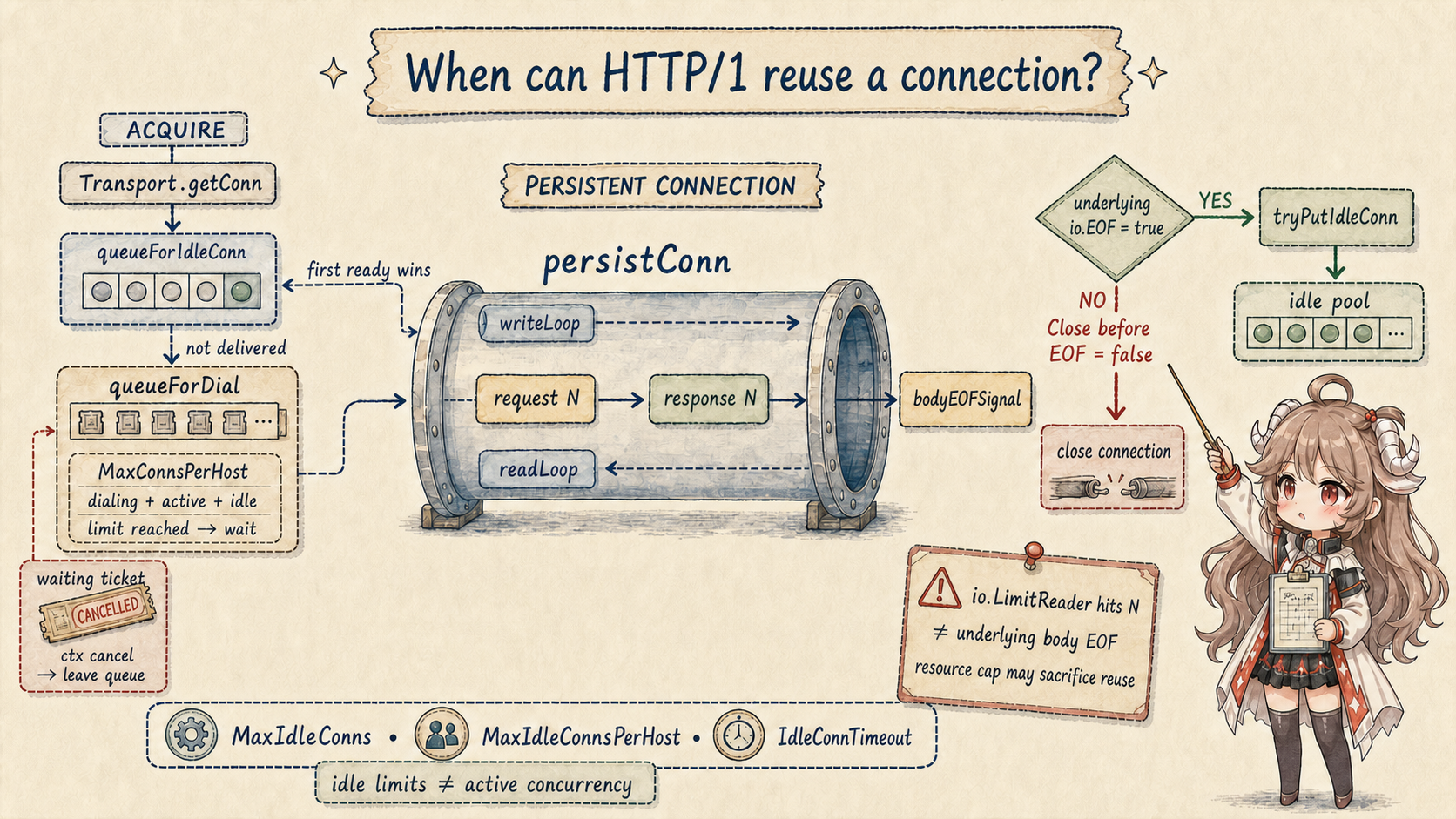
2. HTTP/1: Acquire, Use, and Return a Connection
2.1 getConn Lets Idle and Dial Race for One Ticket
getConn creates a wantConn for the request and calls queueForIdleConn. If no
connection is immediately delivered, it also calls queueForDial. An idle connection may appear first or
the dial may finish first; w.tryDeliver permits only one winner. The source calls this socket late binding:
a request does not have to commit early to waiting for an old connection or building a new one.
if delivered := t.queueForIdleConn(w); !delivered {
    t.queueForDial(w)
}
select {
case r := <-w.result:
    return r.pc, r.err
case <-treq.ctx.Done():
    return nil, context.Cause(treq.ctx)
}
One subtle detail is that the dial context is detached from request cancellation with
context.WithoutCancel, then gets its own internal cancel. A canceled request returns its cancellation error,
while an already-started dial may continue because a future request can use the new connection. This does not ignore
the request deadline; the request stops waiting for that dial, while Transport may retain its result for a future request.
2.2 Total Limits and Retained-Idle Limits Are Different
| Setting | What it counts | At the limit | Common misread |
|---|---|---|---|
MaxConnsPerHost | Dialing + active + idle | New dials queue | Only limits idle |
MaxIdleConnsPerHost | Idle retained for one host | Extra idle closes | Limits concurrent requests |
MaxIdleConns | Idle across all hosts | LRU eviction | A hard total-connection cap |
IdleConnTimeout | Time a connection remains idle | Connection closes | Total request timeout |
With zero MaxConnsPerHost, queueForDial starts a dial directly. With a limit it checks the
current count, then enqueues the ticket in connsPerHostWait when full. Cancellation makes a ticket stop
waiting so queue cleanup can skip it. This wait is not automatically exported by the default metrics; applications
need the GetConn-to-GotConn interval from httptrace or an explicit wrapper.
2.3 HTTP/1 persistConn Has One Read Loop and One Write Loop
After dialing, the HTTP/1 path creates a persistConn. One writeLoop serializes requests and one
readLoop reads corresponding responses. Keep-alive lets requests reuse one connection
sequentially; it does not arbitrarily interleave multiple HTTP/1 responses in one pipe. The read loop
also decides whether the connection remains healthy and when it can call tryPutIdleConn.
request goroutine
  → persistConn.roundTrip
  → writeLoop writes request
  → readLoop parses response
  → caller owns Response.Body
  → readLoop waits for body EOF decision
A response with no body can return to the pool before delivery. With a body, readLoop wraps it in
bodyEOFSignal and waits on waitForBodyRead. Reading the underlying io.EOF sends
the error value io.EOF; closing before a terminal read error sends errClosedEarly. Normal EOF can try the pool directly; early close enters the bounded-drain path below. Both still require no socket EOF, a successfully written request, and a healthy connection.
2.4 Close Releases Resources; It Does Not Promise Reuse
short response: read real resp.Body EOF → Close → connection may return to pool
early close: LimitReader EOF does not prove underlying EOF → Close notifies readLoop and returns
           → eligible: bounded background drain → real EOF permits a pool attempt
           → ineligible, over budget, timeout, or error: close the connection
This development snapshot no longer discards every connection closed before EOF. readLoop first requires a live reusable connection, enabled keep-alive, and ContentLength ≤ 256 KiB; unknown length (-1) also passes. It then allows Close to return and attempts to discard unread data, reading at most 256 KiB + 1 bytes and requiring real EOF within 50 ms before trying the pool. The entry check uses the response ContentLength, not the remaining bytes: a known total above the limit skips draining even if only one byte remains. This uses the current resp.ContentLength; automatic gzip decompression changes it to -1, so the original wire Content-Length is not sufficient to predict this branch. Draining reads the underlying body, so a compressed-byte budget is distinct from the application’s decompressed read cap.
waitForBodyRead := make(chan error, 1)
resp.Body = &bodyEOFSignal{
    body: resp.Body,
    earlyCloseFn: func() error {
        waitForBodyRead <- errClosedEarly
        <-eofc
        return nil
    },
    fn: func(err error) error {
        waitForBodyRead <- err
        // ...
        return err
    },
}
This explains what fetchd does around its 1 MiB response limit:
io.Copy(io.Discard, io.LimitReader(resp.Body, maxResponseBytes)) reaches the real body EOF for a normal
response below 1 MiB, so the connection can be reused. If an upstream response still has data when the limit is reached,
LimitReader returns its own EOF without asking the wrapped resp.Body for underlying EOF.
Deferred Close takes the early-close branch. A known total exceeding 1 MiB also exceeds the 256 KiB entry threshold, so the connection closes. With unknown length, the implementation can still drain a tail within its budget and reuse the connection.
That is not automatically a bug; it is a valid defense against an untrusted response consuming unlimited bandwidth.
Reading untrusted data without limit merely to save a connection is wrong. Also separate the application read cap from actual network bytes: automatic draining consumes some data after the application stops reading. Record truncation, Close return, and eventual reuse separately. To establish pooling completion, observe httptrace.PutIdleConn or a later GotConn rather than Close return. The drain thresholds are implementation details, not API guarantees.
2.5 tryPutIdleConn Serves Waiters before Retaining Idle
Returning to the pool is not an append. tryPutIdleConn first rejects disabled keep-alive or a broken
connection, then marks it reused. If requests wait in idleConnWait, an HTTP/1 connection goes directly to
the first live ticket. Only with no waiter does it enter the per-host idle list and face per-host capacity, global LRU,
and idle timeout.
HTTP/2 already branches here. A pconn.alt != nil connection is not removed from the idle list like HTTP/1,
because the same connection can be delivered to every waiter simultaneously and remain available to future requests.
“Idle” here is an implementation interface for a shareable alternative-protocol connection, not its everyday meaning.
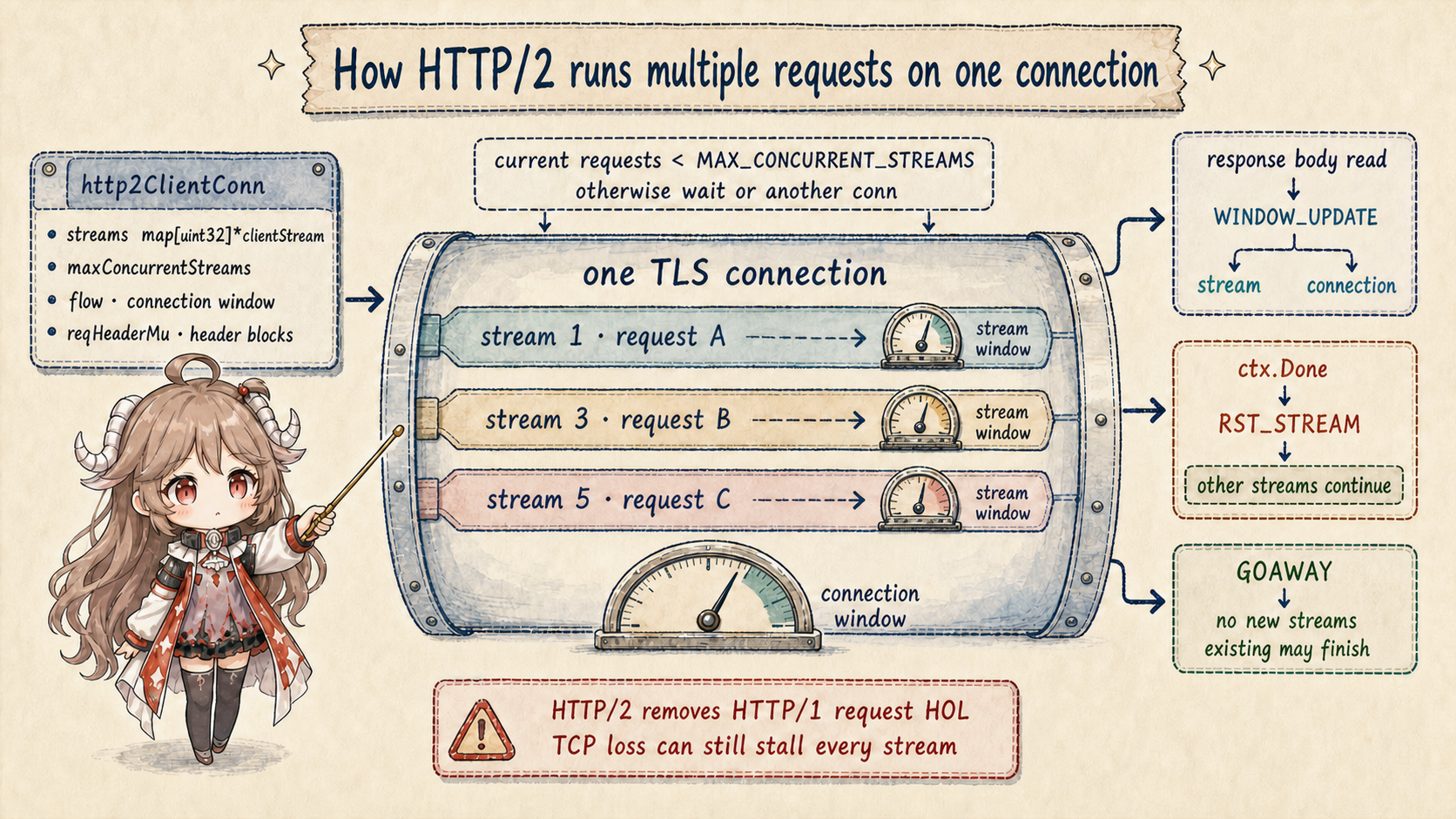
3. HTTP/2 Turns One Connection into Many Streams
Picture two workers fetching pages at once. They share one TCP/TLS passage but hold separate stream tickets, so response frames can interleave. Each ticket has a small cup—the stream flow-control window—and the connection has one shared tank—the connection window. Exhausting either credit makes work wait. Multiplexing removes one bottleneck; it does not remove queues or backpressure.
The internal package’s http2.ClientConn contains the TLS connection, a
streams map[uint32]*clientStream, nextStreamID,
maxConcurrentStreams, a connection-level flow window, and write coordination.
Each RoundTrip creates a clientStream with request context, response-header channel, body pipe, stream
flow window, and abort state, then starts go cs.doRequest. Client-initiated IDs use increasing odd values:
1, 3, 5, and so on.
type ClientConn struct {
    tconn                net.Conn
    flow                 outflow
    inflow               inflow
    streams              map[uint32]*clientStream
    nextStreamID         uint32
    maxConcurrentStreams uint32
    reqHeaderMu          chan struct{}
}

type clientStream struct {
    cc     *ClientConn
    ctx    context.Context
    ID     uint32
    flow   outflow
    inflow inflow
    abort  chan struct{}
}3.1 The Concurrency Limit Is a Stream Slot, Not Just a TCP Count
A connection can take a new request only while it has no GOAWAY, is not closing, has stream IDs available, and has not
exceeded idle rules. Current occupancy includes active streams, reserved slots, and reset streams awaiting
acknowledgment. At the peer's SETTINGS_MAX_CONCURRENT_STREAMS, the connection cannot open another stream.
The public setting in this snapshot is Transport.HTTP2.StrictMaxConcurrentRequests. With its default false value, Transport may create another TCP connection so each
connection independently obeys the peer's per-connection stream limit. With strict=true, it treats that limit globally
and RoundTrip waits when needed. HTTP2Config.MaxConcurrentStreams applies only to Server; it does not configure client concurrency. The default raises parallelism but adds sockets, TLS, and upstream pressure; strict mode
enforces a stricter limit but can form a queue. Applications cannot rely on “HTTP/2 uses exactly one connection.”
transport := http.DefaultTransport.(*http.Transport).Clone()
transport.HTTP2 = &http.HTTP2Config{
    StrictMaxConcurrentRequests: true,
}
This field is from the development snapshot; older toolchains may not provide it.
Usability and slots: isUsableLocked / availableLocked; strict-mode semantics: StrictMaxConcurrentRequests.3.2 Two Levels of Flow Control Make Unread Bodies Consequential
Each stream has a window and the connection has another window shared by all streams. Receiving DATA consumes both.
Only as the application reads response body data does the client accumulate credit and send WINDOW_UPDATE
for stream and connection. A large unread response first stalls its stream; if it occupies the connection receive
window, it can pressure other streams on that connection.
reqHeaderMu is a semaphore for sending new request header blocks without interleaving them; it does not
serialize every response. DATA frames still multiplex. HTTP/2 removes HTTP/1 request-level head-of-line blocking, but
not TCP transport head-of-line blocking: one lost packet delays ordered bytes for every stream on that TCP connection.
3.3 Canceling One Stream Normally Preserves the Connection
roundTrip waits on response headers, stream abort, request context, and the legacy Request.Cancel channel.
Context cancellation calls abortStream and the writer sends RST_STREAM. That stream ends while
other streams continue on the connection. A reset still occupies a concurrency slot until the HTTP/2 implementation’s accompanying PING
confirms the peer received it, limiting new requests sent to a completely unresponsive connection.
GOAWAY is connection state: no new streams begin, while existing accepted streams may finish. The client uses stream ID
and error state to decide whether a retry is safe. Applications cannot retry every error blindly, especially with a
non-replayable body or non-idempotent operation. Use Request.GetBody, idempotency keys, and a retry budget
instead of treating internal Transport retries as business exactly-once.
4. The Lab Proves Reuse, Queueing, and Multiplexing
transport_lab_test.go
first uses httptrace.GotConn to verify HTTP/1. After the first request reads underlying EOF and closes, the
second gets Reused=true and the same net.Conn. For a known-length response above the drain threshold, closing the first body before EOF forces a new connection. That is TestEarlyLargeBodyClosePreventsHTTP1Reuse. Go 1.27 and later also run TestEarlySmallBodyCloseCanReuseAfterDrain from transport_drain_go127_test.go: after early Close on a small response, wait for PutIdleConn before checking reuse, keeping Close return separate from completed draining.
trace := &httptrace.ClientTrace{
    GotConn: func(info httptrace.GotConnInfo) {
        gotConn = info.Conn
        reused = info.Reused
    },
    PutIdleConn: func(err error) {
        putIdle <- err
    },
}
The per-host queue test sets MaxConnsPerHost to one and leaves the first HTTP/1 body unread. A second request
enters GetConn, gets canceled, and must return context.Canceled; the server sees only one request.
The HTTP/2 test warms one TLS connection, then lets two handlers reach a barrier concurrently. Both requests report
HTTP/2, both share the warm connection, and the server's StateNew count remains one. Channels prove concurrency without
guessing with sleeps.
cd go-runtime/examples/fetchd
go test -run 'Test(Transport|EarlyBody|MaxConns|HTTP2)' -count=20
go test ./...
go test -race ./...
go vet ./...
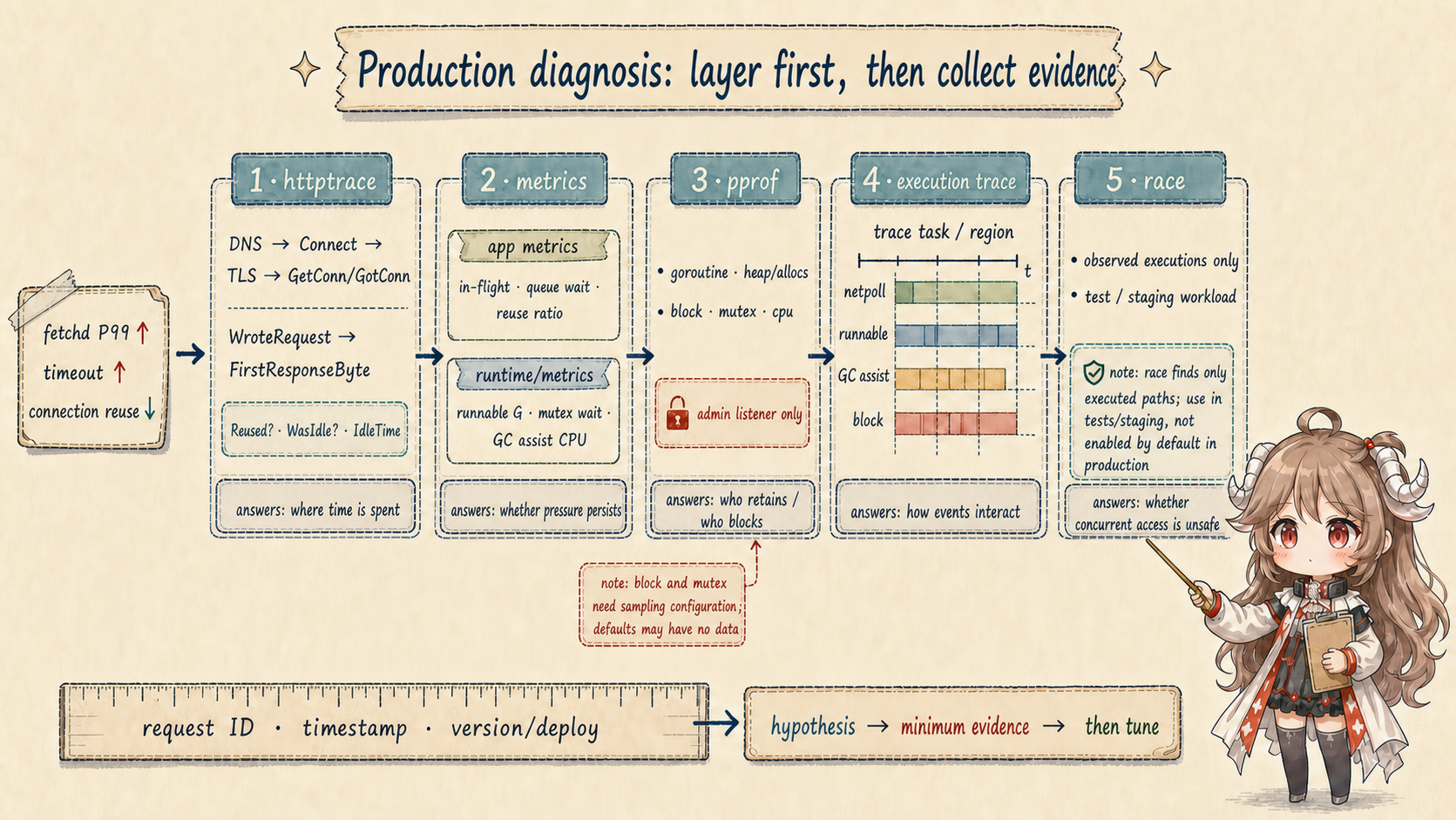
5. Joint Diagnosis Starts by Locating the Slow Layer
One P99 investigation:
httptrace shows GetConn → GotConn growing
  → application metrics confirm the host's in-flight limit
  → a goroutine profile identifies the call stacks waiting in getConn
  → an execution trace separates runnable delay from connection waiting
  → change the capacity or upstream-latency hypothesis and verify with the same metric
When P99 rises, write a falsifiable hypothesis: GetConn queueing, DNS/Connect/TLS, upstream response headers, body reading, runtime runnable delay, locks, GC assist, or a data race? Each tool answers one layer. A goroutine dump cannot simultaneously prove network, pool configuration, and GC. The minimum sequence is request phase → sustained trend → waiting stack → timeline → concurrent-access safety.
| Symptom | Minimum evidence | First hypothesis | Do not start with |
|---|---|---|---|
| GetConn → GotConn grows | httptrace + in-flight / queue wait | Connection cap, body not at EOF, stream slot | Increasing MaxIdleConns |
| Reuse falls; Connect/TLS rises | GotConnInfo + body outcome | Rebuilt Transport, idle timeout, early Close | Blaming DNS first |
| GotConn fast; FirstByte slow | WroteRequest → GotFirstResponseByte | Upstream queue, compute, or proxy | Only tuning the client pool |
| HTTP/2 body stalls | Trace + per-request bytes + server evidence | Stream/connection flow window, TCP loss | Assuming multiplexing cannot block |
| Runnable and GC assist rise | Runtime metrics + execution trace | CPU saturation, allocation burst | Watching only STW |
| Block/mutex profile clusters | Configured delta profile | Channel or lock contention | Using heap to explain lock waits |
5.1 httptrace Splits Client Request Phases
ClientTrace exposes DNSStart/Done, ConnectStart/Done, TLSHandshakeStart/Done, GetConn, GotConn,
WroteRequest, and GotFirstResponseByte hooks. GotConnInfo adds Reused, WasIdle, and IdleTime.
It is excellent for “where was time spent?” but remains the client's observation, not server-side execution truth.
trace := &httptrace.ClientTrace{
    GetConn: func(hostPort string) { phase("get_conn", hostPort) },
    GotConn: func(info httptrace.GotConnInfo) {
        gauge("conn_reused", boolToFloat(info.Reused))
        observe("idle_seconds", info.IdleTime.Seconds())
    },
    GotFirstResponseByte: func() { phase("first_byte", "") },
}
req = req.WithContext(httptrace.WithClientTrace(req.Context(), trace))Compute phase durations with monotonic time and attach one request ID. Do not create unbounded metric labels per request. Fine phases belong in traces or spans; reuse ratio, queue-duration histograms, and timeout reasons belong in bounded aggregates. Upstream execution requires a server-side span or log, aligned through a trace ID.
5.2 Metrics Show Trends; pprof Finds the Waiting Code
HTTP pool in-flight, GetConn wait, reuse ratio, and early-close reason are application metrics.
Standard runtime/metrics does not export Transport pool state. Runtime signals such as
/sched/goroutines/runnable:goroutines, /sched/latencies:seconds,
/sync/mutex/wait/total:seconds, and /cpu/classes/gc/mark/assist:cpu-seconds reveal whether
pool symptoms coexist with CPU, lock, or GC pressure.
pprof answers “who.” Goroutine profiles show where requests accumulate; heap and allocs distinguish retention from
allocation traffic; CPU finds computation; block and mutex locate synchronization waits. The latter two may have too
little data by default. Deliberately configure runtime.SetBlockProfileRate and
SetMutexProfileFraction, bound the collection window, and restore settings afterward.
go tool pprof 'http://admin/debug/pprof/goroutine'
go tool pprof 'http://admin/debug/pprof/heap'
go tool pprof 'http://admin/debug/pprof/block?seconds=30'
go tool pprof 'http://admin/debug/pprof/mutex?seconds=30'
go tool pprof 'http://admin/debug/pprof/profile?seconds=30'
Put pprof behind a separate admin listener, authentication, and network access control. Goroutine
stacks, command lines, and profiles can expose internal paths and request data. Convenience does not justify publishing
net/http/pprof on the public service listener. Profiles also cost resources, so bound time and sampling.
5.3 Execution Trace Supplies the Timeline; Race Checks Access Safety
Execution traces place goroutine runnable states, network blocking/netpoll, syscalls, GC, and mark assists on one
timeline. Create a trace.NewTask for one fetch batch and a trace.WithRegion around each
outbound fetch, then align structured logs with the request ID. GetConn wait, worker runnable delay, assist, and response
completion can then explain one another instead of relying on screenshot order.
ctx, task := trace.NewTask(ctx, "fetch-batch")
defer task.End()

trace.WithRegion(ctx, "outbound-fetch", func() {
    h.fetch(ctx, target, results)
})
The race detector answers a different question: did an executed path contain an unsynchronized conflicting access?
It cannot prove the absence of races and does not replace memory-model reasoning. Its overhead also makes it unsuitable
as a default production mode. Turn real concurrency into tests or staging replay and run go test -race so
transport reload, metric maps, trace callbacks, and shutdown registries are actually exercised.
5.4 Deliverables for a Reproducible Incident
- Symptom window: P50/P99, timeout reasons, request rate, version, and deploy time.
- Request phases: GetConn wait, reuse, DNS/Connect/TLS, first byte, and body duration.
- Resource trends: in-flight, queue, connections/streams, runnable G, mutex wait, and GC assist CPU.
- Call-stack evidence: goroutine/CPU/heap or delta block/mutex profiles from the same window.
- Timeline: a controlled 5–10 second execution trace carrying tasks, regions, and request IDs.
- Minimum reproduction: use channels and barriers like the transport lab, not sleeps that guess state.
- One-variable correction: fix when a body closes, which code retains a resource, or a hotspot before changing connection and stream controls separately.
- Regression criteria: correctness, race, resource caps, and tail latency all pass.
We can now retrace one fetchd request through the whole series: values and aliases, goroutine scheduling, channels and locks,
interface/generic/reflection type choices, context termination, allocation and GC, then connection reuse and production
evidence. The reusable rule is simple: use source to build a mechanism model, then prove that the current system
actually takes that path with a minimum experiment and production evidence.
Source and documentation map
- net/http Transport documentation
- getConn and per-host dial queue
- Idle connection delivery and pooling
- persistConn.readLoop and body EOF decision
- bodyEOFSignal
- HTTP/2 client connection and stream state
- HTTP/2 RoundTrip and cancellation
- HTTP/2 connection and stream flow control
- net/http/httptrace documentation
- runtime/metrics documentation
- net/http/pprof documentation
- Go diagnostics
- Data race detector
- fetchd transport lab