Part I crossed more than a dozen plugins in one turn: a model adapter prepared the request, prompt and tool assemblies met before a step, persistence subscribed to SessionEvent, approval and sandbox plugins governed effects, and Web observed the same run. Why can those components be replaced without trampling startup order, dependencies, and cleanup?
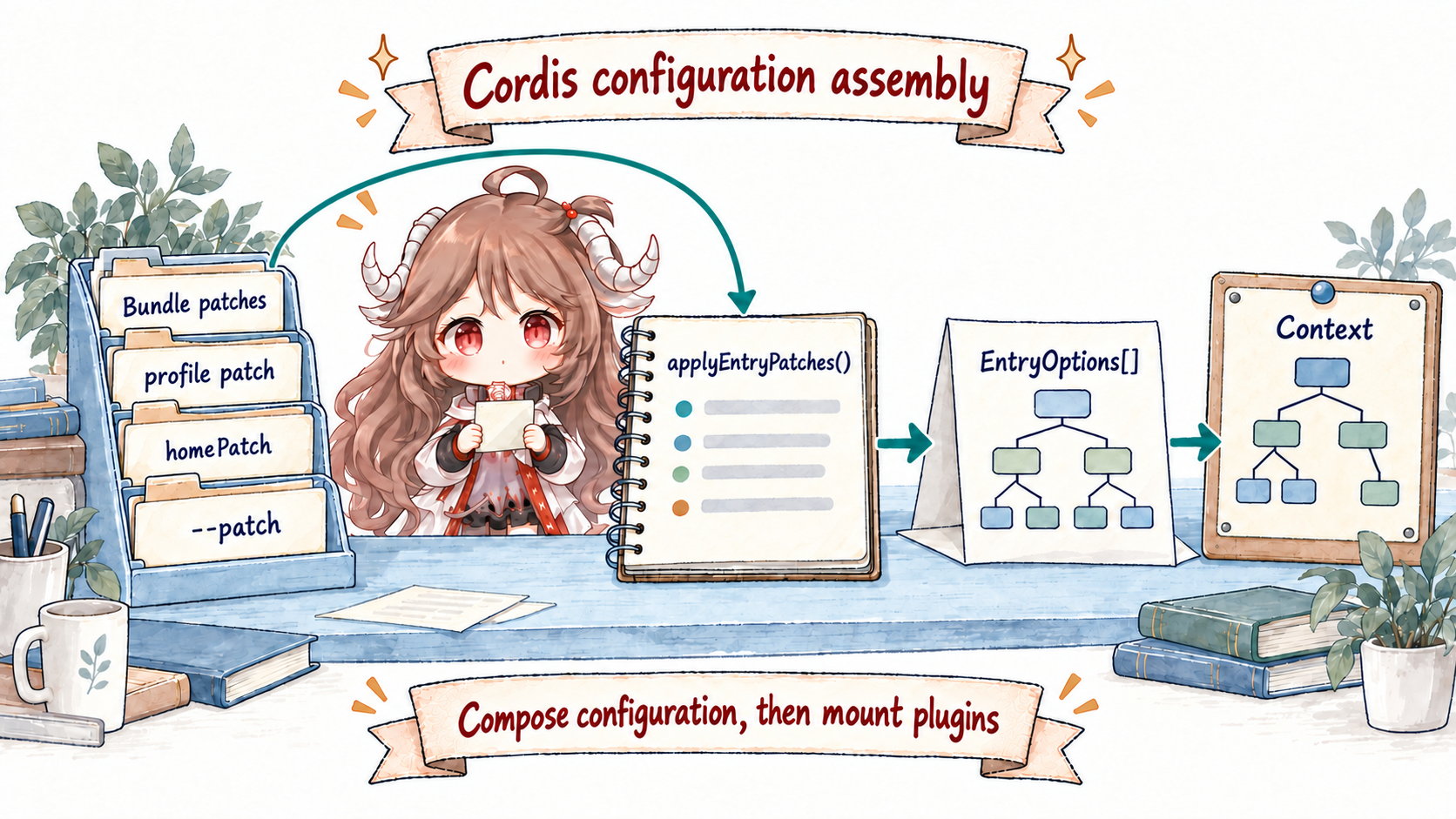
The answer is not a single plugin-manager object but two complementary protocols. Before boot, applyEntryPatches() compresses several sources into one deterministic configuration tree. After boot, Cordis Context, Service, and Fiber decide where a capability is visible, when it may activate, and who releases it.
Reading contract.After this chapter, you should be able to explain why a profile override must restate a complete config; why !!js must not evaluate during a config dump; how extend() and isolate() produce different service resolution; why a plugin stays PENDING without an injection; and why configuration reconciliation and module replacement share one HMR queue without sharing one transaction guarantee.
Evidence boundary.The chapter is pinned to ddefc45. DSH carries its patched Cordis fork under vendor/, so Context, Service, and Fiber claims come from the same snapshot. These contracts do not imply that every third-party plugin is safe or compatible.
1. Compose one tree before anything starts
1.1 Boot and dump share the same algorithm
vendor/include exports the pure function applyEntryPatches(data, patches, warn). composeEntries(), the boot include, and dsh --dump-config all call it instead of implementing approximate merges. The diagnostic tree and mounted tree therefore share one id index, insertion order, and warning policy.
This prevents a subtle but severe failure: a dump tool that deep-merges while boot replaces whole objects could show a valid-looking configuration that never runs. DSH prefers an explicit failure over a split between displayed and effective configuration.
1.2 A patch is an ordered operation, not YAML deep merge
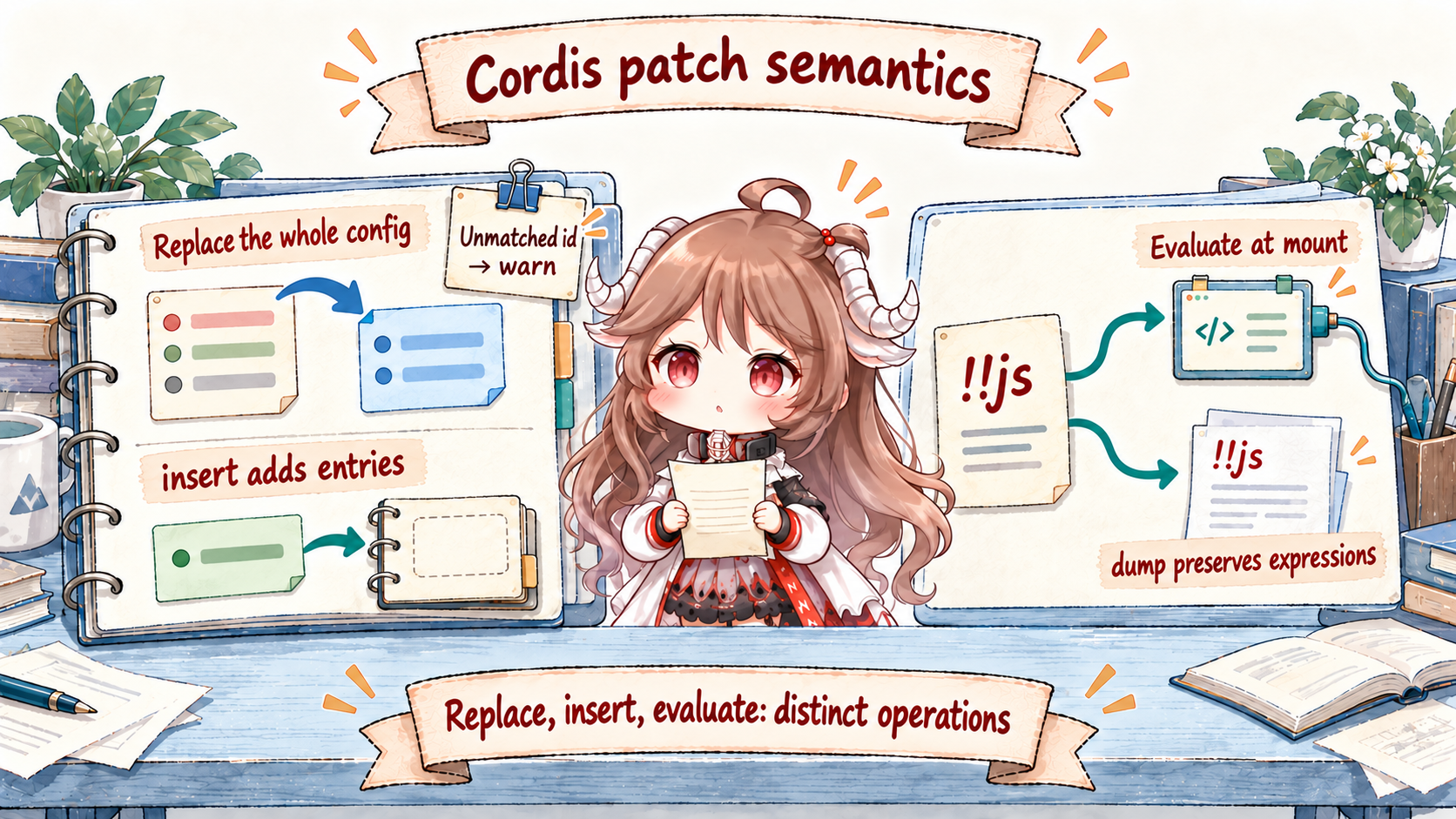
PatchOptions has two central actions: find an entry by id and replace fields, or add entries through insert. The critical DSH rule is that an id-targeted patch replaces the entire config; it does not recursively merge fields. Any bundle setting that must survive has to be restated.
- id: llm-deepseek
  config:
    model: deepseek-chat
    apiKey: !!js process.env.DEEPSEEK_API_KEY
- insert:
    - id: local-plugin
      name: ./local-plugin.mjs
!!js is not arbitrary code executed by the YAML parser. It remains an expression node. The Loader waits until declared injections are active, then resolves it through internal/config in the entry's own context. --dump-config prints the expression verbatim, so a diagnostic command does not depend on runtime environment or trigger its effects.
An entry inserted earlier in one list is immediately indexed, allowing later patches to configure or disable it. An unmatched id is sent to warn() rather than swallowed; config dumps also identify its layer. A misspelled plugin id becomes a visible diagnostic.
2. Context defines the local world of service resolution
2.1 The root Context installs four built-in services
Context constructs a root Fiber and installs reflect, registry, events, and logger. Context is a Proxy: normal property reads go through the service resolver, while methods such as ctx.plugin(), ctx.inject(), and ctx.on() are mixed in by the built-ins.
A plugin's ctx is therefore not a global service bag. It is a scoped view carrying a parent chain, isolation map, intercept map, and current Fiber. Two plugins reading ctx.llm can resolve different providers when their scope labels differ.
2.2 extend inherits; isolate redirects one service domain
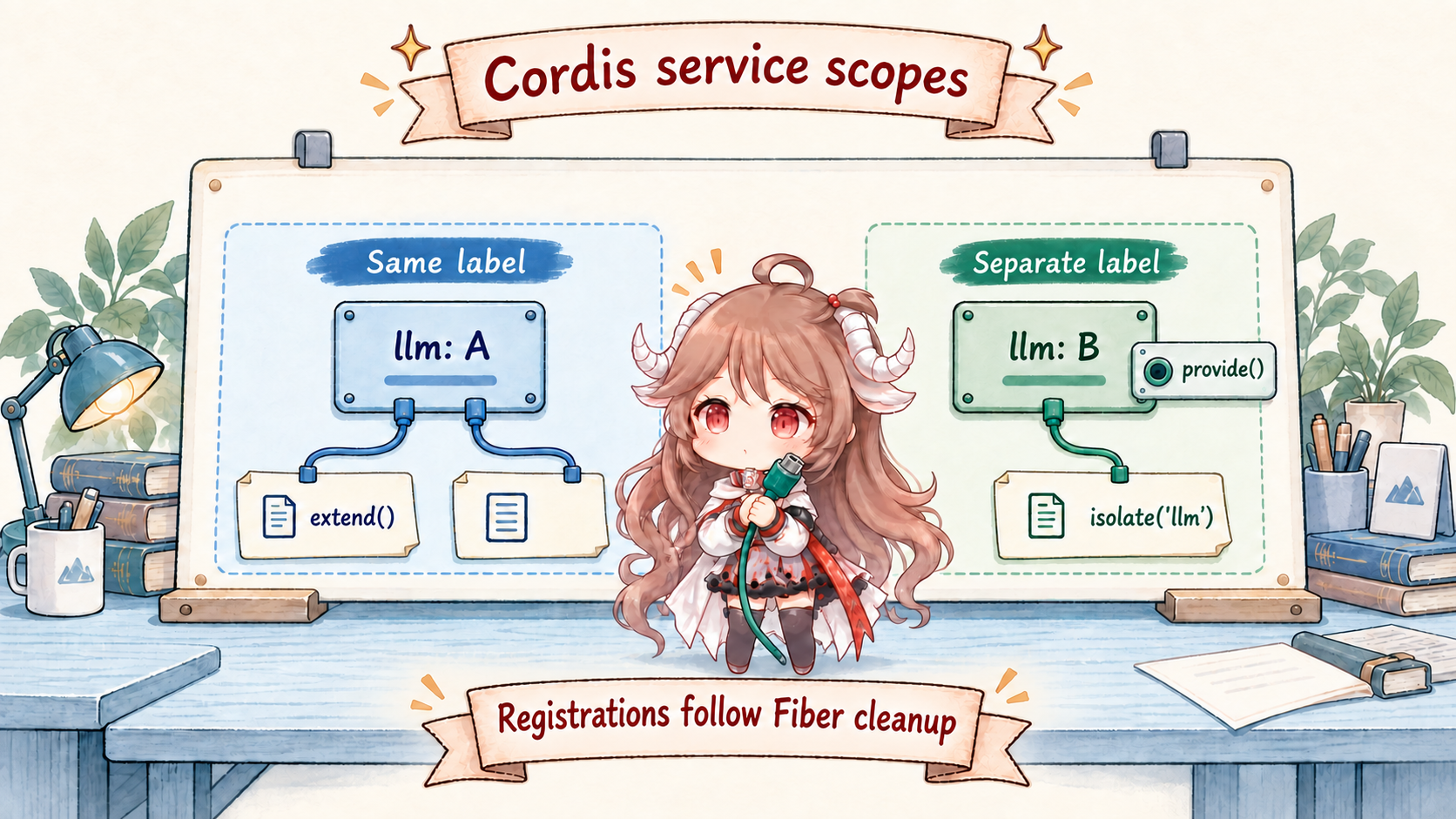
extend(meta) creates a prototypal child without mutating its parent. With no isolation change, service reads keep the same label. isolate(name, label) copies the isolation map and changes only the selected service name. Provides and reads beneath that child enter a new resolution domain; all other services continue through the parent scope.
This fits an agent runtime well: a subtree may replace its LLM, session store, or approval provider without cloning the application. The same label can deliberately join two branches. intercept(name, config) keeps the provider identity but merges service-specific configuration from root toward the current scope.
| Operation | What it changes | What it preserves |
|---|---|---|
extend() | Adds metadata to a child context. | Service labels and the parent object remain unchanged. |
isolate() | Redirects one service name to another label. | All other services inherit normally. |
intercept() | Adds local configuration for one service. | Does not replace the provider. |
provide() | Registers an implementation in the current label. | The registration belongs to its Fiber rather than global state. |
3. Service couples capability registration to ownership
3.1 Constructing a Service registers the provider
The Service base calls ctx.reflect.provide(name, this, check) from its constructor. This is not a raw Map write: the provide operation becomes an effect owned by the current Fiber, and the provider disappears automatically when that Fiber unloads.
export class SessionStore extends Service {
  constructor(ctx: Context) {
    super(ctx, 'sessions')
  }
}

await ctx.plugin(SessionStore)
const store = ctx.get('sessions')
That removes the dangling state in which a plugin has unloaded but its service still points at an old instance. Callable services, Config schemas, and intercept configuration stay on the same contract. Consumers declare injection names rather than importing a concrete provider.
3.2 Injection is an activation condition, not a later null check
After a runtime declares required services, Registry creates a Fiber. Missing dependencies keep it PENDING. When providers appear, the Fiber enters LOADING, snapshots their implementations, then resolves and validates configuration; only a completed callback and init hooks make it ACTIVE. Provider replacement or disappearance unloads the old activation or returns it to a waiting path.
Startup order thus becomes a dependency graph rather than handwritten sequencing. Entry order still affects the tree and hook order, but an unavailable capability is never represented as an active plugin that may fail later at an arbitrary read.
4. Fiber turns lifecycle into structured ownership
4.1 Every effect belongs to the current Fiber
Fiber tracks validated configuration, required-service snapshots, effects, disposers, errors, and state transitions. Resources created through ctx.on(), ctx.provide(), or ctx.effect() join that Fiber; unload starts disposers in reverse registration order and waits for all of them to settle.
Reverse order means later synchronous cleanup starts first. Because _unload() awaits the batch with Promise.all, asynchronous disposers need not finish serially. If an event stream must finish stopping before a worker terminates, put both steps in one async disposer with an explicit await. Repeated disposal joins cleanup already in progress rather than executing it twice.
4.2 HMR coordinates two different update paths
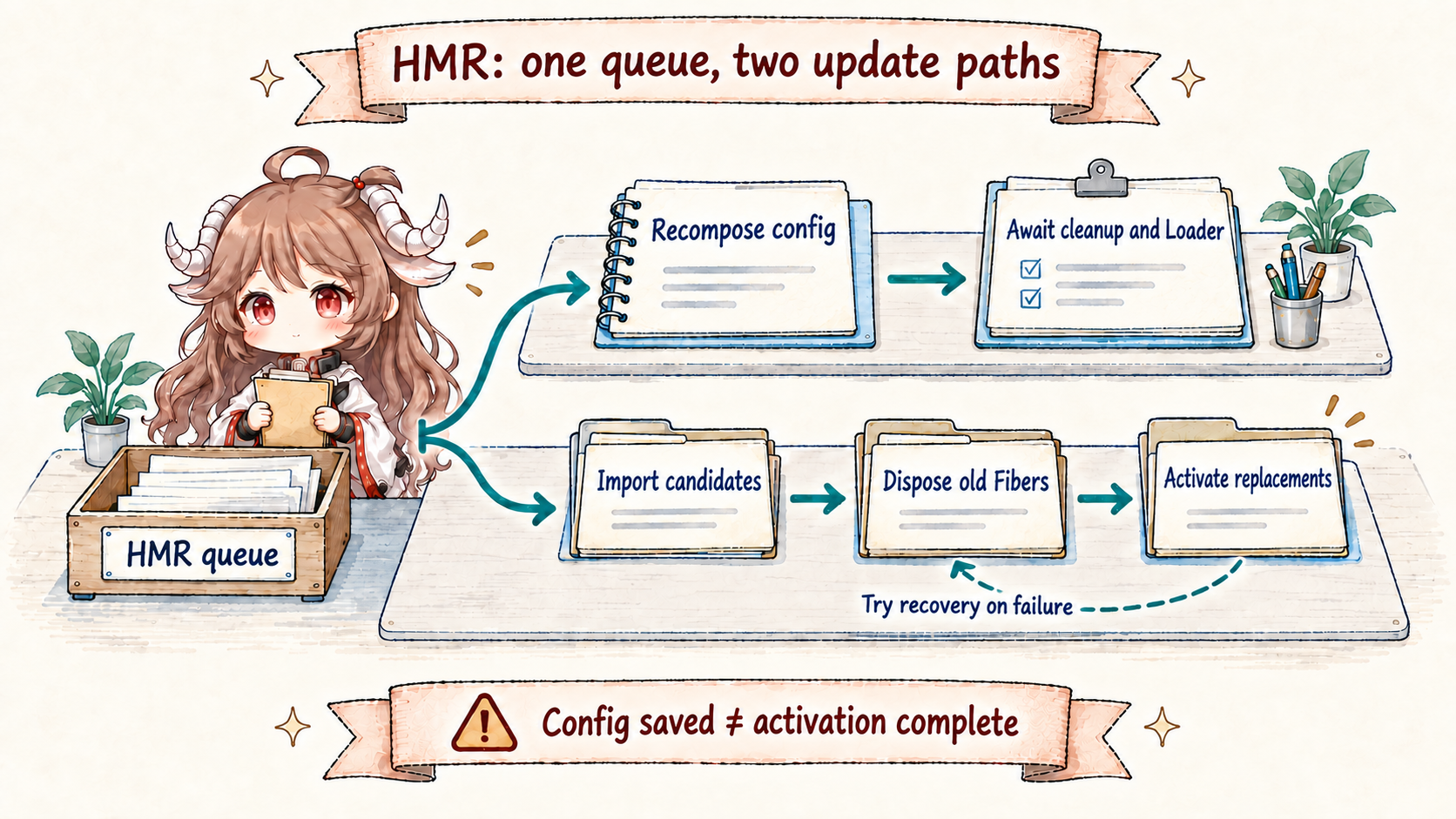
Profile patches, home patches, and source files can change together. Independent refreshes would interleave old-entry cleanup with new-entry loading. Current @deepseek-ai/dsh-hmr serializes configuration writes, Include refreshes, and module replacements through runExclusive(), rejecting nested transactions. Package downloads and installation run outside the queue; successful installation enters configuration application afterward.
For configuration, HMR watches the profile bundle list and both user patch files. After application readiness, it rereads the layers and calls reconcileProfilePatches() on the original root Include. Reconciliation awaits both previously held Fibers and the current Loader, so removed entries must finish asynchronous cleanup even after leaving the entry store. New or changed activation failures reject the application; unchanged pre-existing inactive entries become warnings. This is not a guarantee that the whole configuration tree rolls back automatically.
Source-module replacement follows a different order: import candidate modules, delete old registrations and await their Fibers, then register and await replacements. Import failure restores module caches. Replacement activation failure removes the replacement, restores caches, and attempts to register the old implementation again. The old implementation has already stopped during that window, and recovery can itself fail; this is not a seamless exchange that keeps the old generation alive until the new one becomes ACTIVE.
For example, enabling a plugin whose required Service is missing may save the configuration but fail the application audit with PENDING. Repairing the dependency or disabling the entry is a separate next action. HMR also does not make every installed-package upgrade reloadable: Plugin Manager still requires a restart for package-version replacement. A profile without HMR reads configuration changes on its next startup.
5. Four questions locate composition failures
- Was the tree composed correctly?Use
--dump-configto verify ids, insertion positions, layer sources, and whole-config replacement. - Did the module resolve?Check the profile module resolver, installation and profile dependency sources, and the entry's base URL.
- Are dependencies satisfied?Inspect a PENDING Fiber and whether provider and consumer use the same isolation label.
- Did lifecycle converge?Verify failed generations, provider replacement, and disposal—not merely whether the plugin callback ran once.
Those are composition, resolution, injection, and ownership failures. Calling all four “the plugin did not load” forces debugging to bounce between YAML, imports, service lookup, and leaked resources.
Part III moves from the plugin tree to SessionEvent. When the loop, tools, and UI are replaceable, what remains the shared runtime fact? DSH's answer is that model-visible state must first enter a projectable event log.
Source references
- profile-boot.ts and profile.ts: bundle, profile, home, and CLI patch layers.
- vendor/include: PatchOptions, expression nodes, and applyEntryPatches.
- Context, Service, and Fiber: scopes, capabilities, and lifecycle.
- app-boot README: mounting, config dumps, user patches, and activation diagnostics.
- DSH HMR: the shared queue, configuration watches, module teardown, and failure recovery.