Chapter one uses a ninety-second AI music video to ask how a long-running job survives processes. Chapter two switches to
“How a City Wakes at Night,” an animated explainer, because OpenMontage's animated-explainer manifest exposes research,
proposal, script, scene plan, assets, compose, and publish. The examples do not share one business pipeline, but they face the same waits,
failures, revisions, external calls, and human acceptance. That production pressure contains at least two different systems problems.
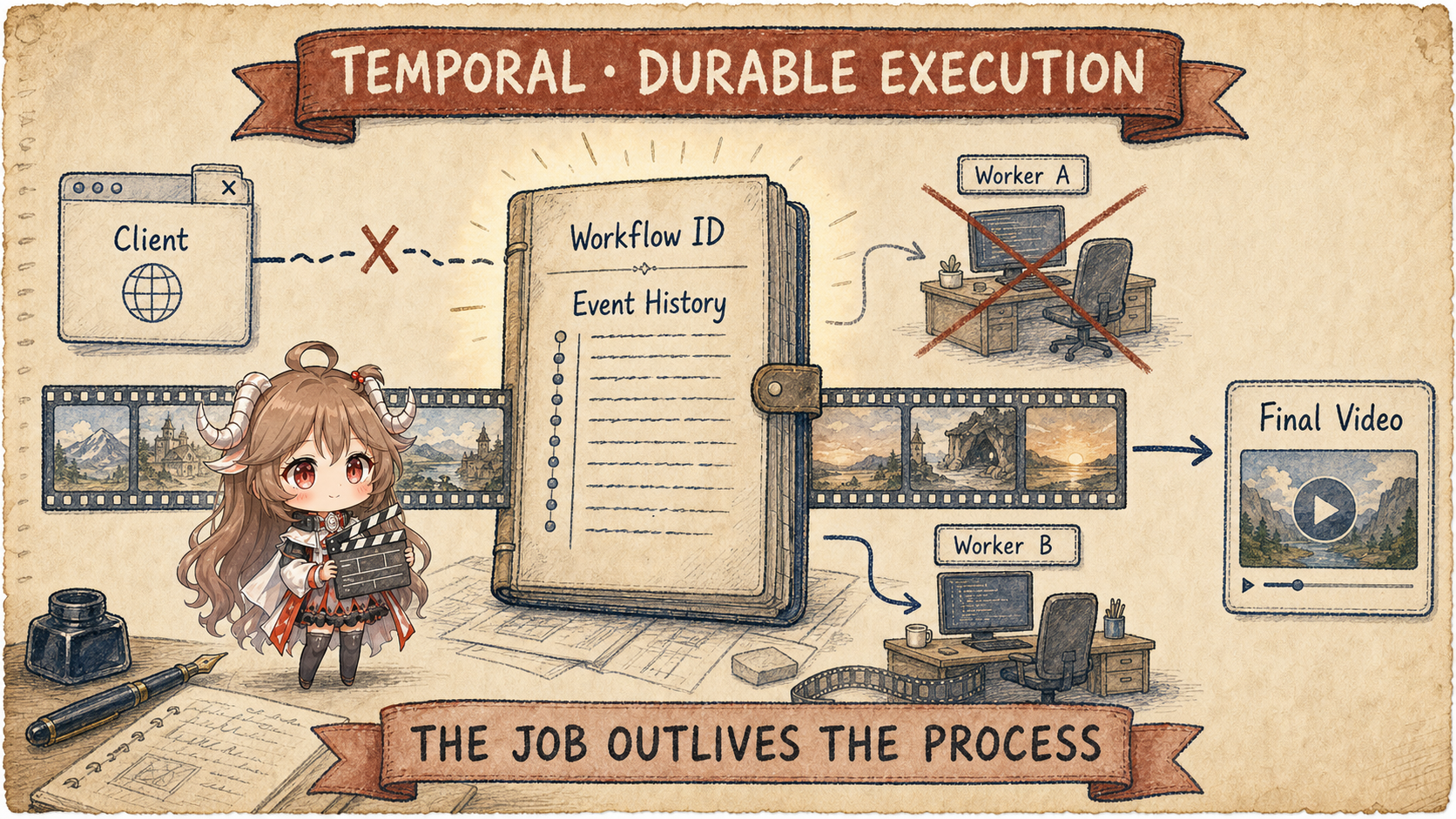
The first is durable job identity: after a browser disconnect, Worker restart, or provider timeout, does the job retain the same identity, and can the system prove what happened? The second is production discipline: how does the agent know the current stage, locked decisions, human gates, available tools, and the acceptance work that still follows a successful render?
Reading contract. After both chapters, you should be able to name four owners: the owner of long-running identity, creative decisions, external execution, and delivery approval. You should also be able to explain why checkpoint files are valuable without confusing them with durable execution.
1. The series is divided by production responsibility
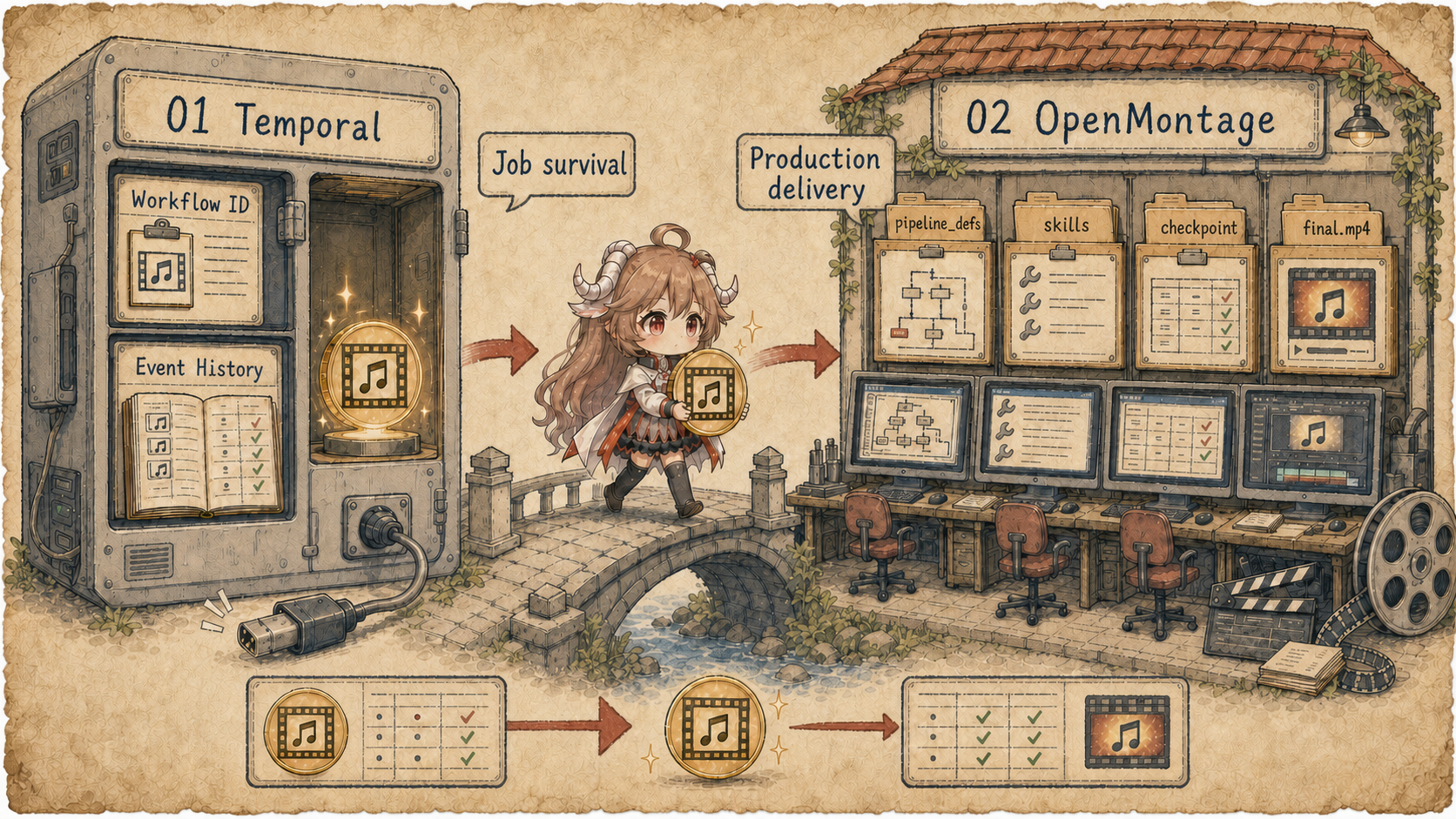
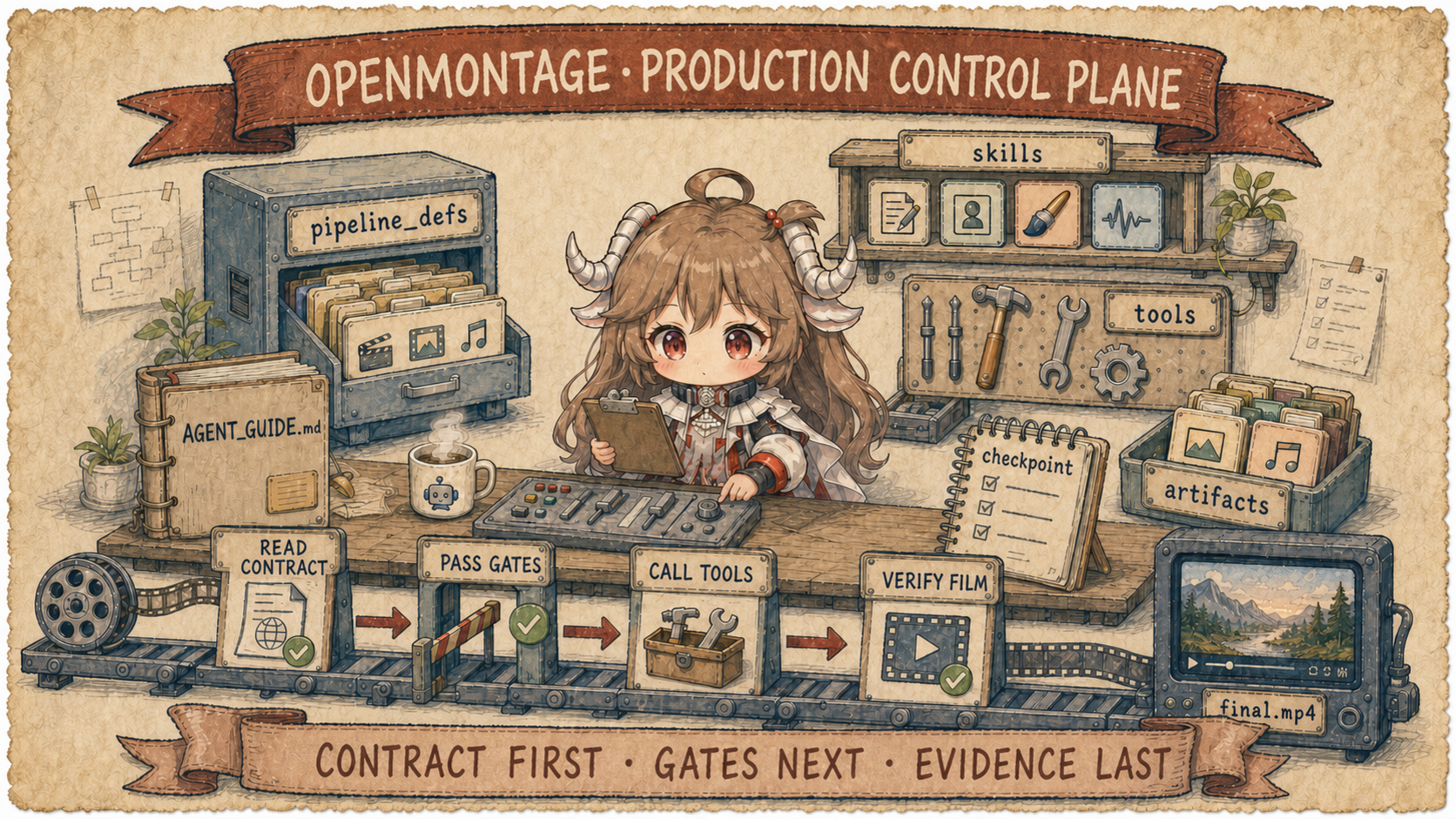
Temporal and OpenMontage are not competing products, and OpenMontage does not use Temporal internally. Reading them together makes the seam visible: one system lets execution identity survive processes; the other shows how a coding agent can operate a video production through instruction contracts, manifests, checkpoints, and a tool registry.
User request: produce an AI video
Business life
Which job is this?
What is confirmed to have happened?
Who can continue after a process disappears?
-> Chapter 01 · Temporal
Production control
Which stage is active?
Which creative decisions were approved?
Which providers and renderers are available?
What makes the final file deliverable?
-> Chapter 02 · OpenMontage
2. Reading route
3. The seam between the chapters
| Responsibility | Temporal chapter | OpenMontage chapter |
|---|---|---|
| Durable identity | A Workflow Execution and stable Workflow ID. | A project directory and project.json marker. |
| Historical facts | Server-side append-only Event History used for replay. | Stage checkpoints, decision_log.json, and files under history/. |
| Next step | A Workflow decides deterministically from history. | The agent follows the manifest and stage-director instructions. |
| External action | An Activity executes through a Worker. | ToolRegistry discovers and routes tools by capability. |
| Human boundary | Signals or Updates plus application code. | The manifest declares gates; checkpoint code rejects an unapproved completion. |
| Recovery promise | A new Worker can rebuild control flow after process loss. | A new agent session can read files and resume project work from a checkpoint. |
The final row is the essential distinction. OpenMontage turns expensive creative work into inspectable, resumable project state. Temporal turns control flow itself into an execution identity recoverable across processes. A production system may need both, but shared words such as “checkpoint” and “resume” do not make them the same layer.